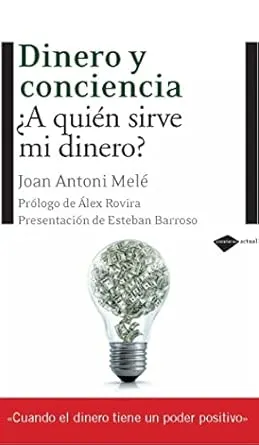
Cover of Money and Conscience
Spanish authors

Money and Conscience

★★★★☆ No ratings 1 min read

Joan Antoni Melé, who spent years as deputy general manager of Triodos Bank in Spain, writes from the direct experience of someone who has managed money under ethical principles within a conventional financial system.

Affiliate CTA preview · enabled with monetization (phase 5).

Former Triodos Bank Spain executive and ethical finance reference Joan Antoni Melé proposes a radical reflection on the relationship between money and values: what we do with our savings, who manages them, where they are invested, and the social and environmental consequences of our financial decisions. Presents ethical banking and socially responsible investing as concrete alternatives.

Our review

Joan Antoni Melé, who spent years as deputy general manager of Triodos Bank in Spain, writes from the direct experience of someone who has managed money under ethical principles within a conventional financial system. The book poses an uncomfortable question for any investor: is it possible to make money reflect the values of those who hold it? Melé does not propose rejecting the financial system but transforming it from within through conscious decisions about where savings are deposited, what is invested in, and what kind of economy is fed by each choice. The text combines philosophical reflection with practical examples of ethical finance and alternative banking. Its greatest contribution is broadening the investor's analytical framework beyond the return-risk binomial to include social and environmental impact. The book's weakness is that the tone occasionally becomes more normative than analytical, which may feel excessive to readers with a more pragmatic view of finance. It is, in any case, a reading that compels an examination of the assumptions we take for granted when making financial decisions.

Who it's for

For investors and savers interested in ethical finance, impact investing, or alternative banking; less compelling for those focused exclusively on return optimisation.

Key takeaways

  • Everyday financial decisions — where savings are deposited, what is financed — have concrete social and environmental consequences.
  • Ethical finance is not incompatible with economic viability: Triodos Bank demonstrates this as a real-world case study.
  • The concept of return can be expanded to include non-monetary dimensions without implying economic naivety.
  • Melé argues that financial system transformation begins with individual decisions, not only with regulation.
Fact

Triodos Bank, where Melé worked for many years, was founded in 1980 in the Netherlands and operates in several European countries, financing exclusively projects with positive social, environmental, or cultural impact.

Topics Joan Antoni MeléTriodos Bankfinanzas éticasISRbanca ética