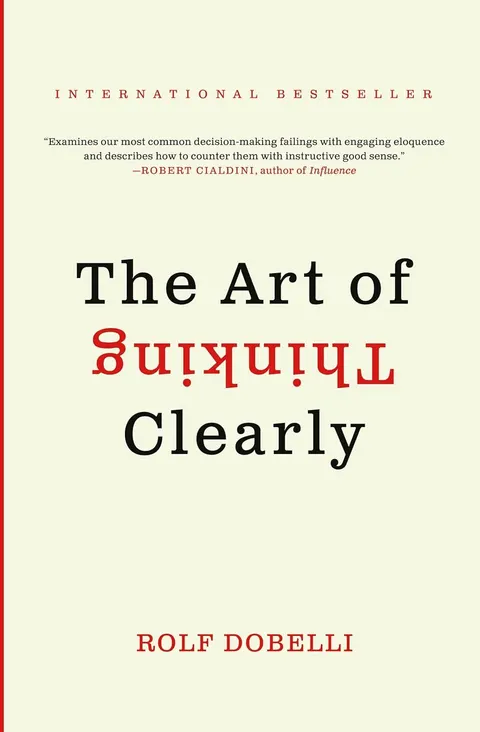
Cover of The Art of Thinking Clearly
Psychology & decisions

The Art of Thinking Clearly

★★★★☆ No ratings 1 min read

«The Art of Thinking Clearly» by Rolf Dobelli is a systematic catalogue of 99 cognitive errors arranged in brief, self-contained chapters designed to be read in any order and picked up easily.

Affiliate CTA preview · enabled with monetization (phase 5).

Rolf Dobelli catalogs 99 thinking errors in brief chapters — confirmation bias, the halo effect, survivorship bias, herd thinking — each illustrated with a memorable story. For investors, a cognitive defense manual against market pressure mistakes.

Our review

«The Art of Thinking Clearly» by Rolf Dobelli is a systematic catalogue of 99 cognitive errors arranged in brief, self-contained chapters designed to be read in any order and picked up easily. The format works: each bias — confirmation bias, the halo effect, survivorship bias, the anchoring effect — is illustrated with a concrete example and explained in two or three pages, without academic apparatus but with sufficient rigor. The application to financial and investment decisions is not the book's exclusive focus — Dobelli writes about decision-making broadly — but many of the biases described have direct implications for how investors evaluate opportunities, interpret market news, or follow the crowd. The main academic criticism of the book is that Dobelli draws examples from researchers such as Kahneman or Cialdini without citing their original work with appropriate rigor, and that the solution he proposes — «recognize the bias to avoid it» — underestimates the real difficulty of overcoming cognitive biases, which persist even when they are known. Even so, as a practical introduction to the psychology of decisions, it delivers high informational density per unit of reading time.

Who it's for

For anyone interested in improving decision quality; particularly useful as a light introduction to behavioral economics before tackling more rigorous works such as «Thinking, Fast and Slow».

Key takeaways

  • Confirmation bias leads us to seek information that reinforces existing beliefs and ignore contradicting evidence — particularly dangerous when analyzing an investment thesis.
  • Survivorship bias makes us see only visible successes while ignoring the failures that disappeared, distorting our assessment of real risk.
  • The anchoring effect shows that the first number we hear in a negotiation or valuation disproportionately influences all subsequent judgments.
  • Knowing a bias does not eliminate it; the real challenge is implementing decision processes that structurally contain it.
Fact

Rolf Dobelli is co-founder of getAbstract, the non-fiction book summary service, and published «The Art of Thinking Clearly» in 2012.

Topics sesgos cognitivospensamiento críticoDobellierrores de razonamientotoma de decisiones