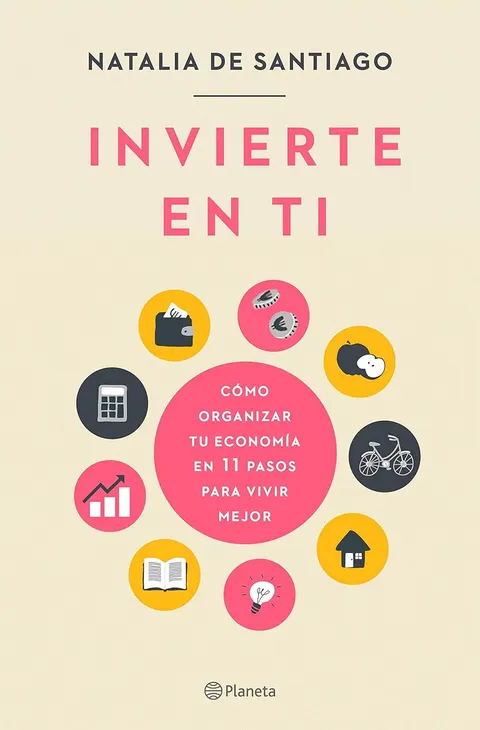
Cover of Invest in Yourself
Personal finance

Invest in Yourself

Cómo organizar tu economía en 11 pasos para vivir mejor

★★★★☆ No ratings 1 min read

Natalia de Santiago came to financial education from applied economics and teaching, and that background shows in "Invierte en ti" (Invest in Yourself): the book has structure, rigor, and pedagogical sequence — qualities that are not common in the genre.

Affiliate CTA preview · enabled with monetization (phase 5).

One of Spain's most-followed financial educators presents a comprehensive approach to personal financial education, from budget management and money psychology to long-term investing. Written accessibly for anyone taking control of their finances for the first time, balancing just enough theory with practical action steps.

Our review

Natalia de Santiago came to financial education from applied economics and teaching, and that background shows in "Invierte en ti" (Invest in Yourself): the book has structure, rigor, and pedagogical sequence — qualities that are not common in the genre. The approach is comprehensive: Santiago does not begin with investment assets but with the emotional and behavioral relationship with money, before moving through budgeting fundamentals, debt, saving, and finally long-term investing. The sequencing makes sense from a behavior-change perspective: without a prior mindset shift, technical tools are applied inconsistently. The book is written in direct language, without unnecessary jargon, and with examples adapted to the Spanish context. Its limits are shared with the genre: in a fast-evolving field — products, interest rates, taxation — specific content ages. But the conceptual framework is solid. For someone who has read Anglo-Saxon books like Ramit Sethi's or Dave Ramsey's and has been looking for something rooted in Spanish reality, this book fills that gap competently.

Who it's for

For the Spanish reader who wants a complete view of personal finance — from money psychology to investing — with context adapted to Spain.

Key takeaways

  • Effective financial education starts with recognizing emotional and behavioral patterns around money, not with choosing assets.
  • A realistic, sustainable budget is the foundation of any investment plan; without systematic saving, there is no capital to invest.
  • Debt is not inherently bad, but its real cost — including opportunity costs — is rarely calculated correctly.
  • Investing in one's own professional development and health offers returns that no financial asset can guarantee.
Fact

Published in 2021, "Invierte en ti" reached multiple print runs in Spain, and Natalia de Santiago was recognized as one of the most influential Spanish-language financial educators in the years that followed.