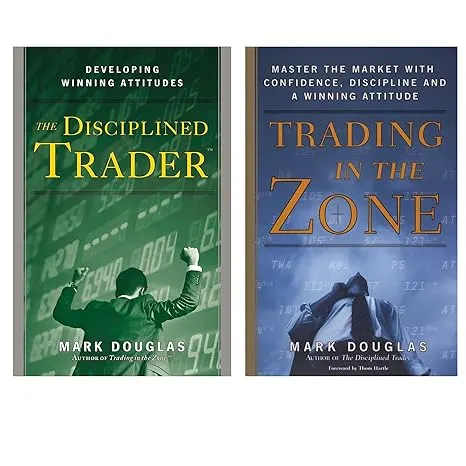
Cover of The Disciplined Trader
Trading & technical analysis

The Disciplined Trader

Developing Winning Attitudes

★★★★½ 10.0/10 (2) 1 min read

Published in 1990, «The Disciplined Trader» is Mark Douglas's first book and the text that inaugurated trading psychology as a serious field of study in financial literature.

Affiliate CTA preview · enabled with monetization (phase 5).

The pioneer of modern trading psychology. Douglas observes that most traders fail not from lack of technical knowledge but from psychological problems: inability to execute the plan, fear of being wrong, need to control the market. He proposes a complete mental framework for consistent discipline — think like a casino, not a gambler.

Our review

Published in 1990, «The Disciplined Trader» is Mark Douglas's first book and the text that inaugurated trading psychology as a serious field of study in financial literature. Douglas starts from an observation that any experienced trader will recognise: traders who fail usually do not do so from technical ignorance but because their emotional reactions to uncertainty — fear of losing, attachment to a trade, overconfidence after a winning streak — systematically sabotage their plan. The book argues that consistent, profitable trading requires a deep restructuring of the trader's relationship with uncertainty, error, and money. Douglas writes as a behavioural psychologist rather than a technician, and the book reflects that focus: there are few references to specific indicators or systems, and much attention to the cognitive and emotional mechanisms underlying decisions. The text is demanding, conceptually dense, and occasionally repetitive; but traders who absorb it tend to find it genuinely transformative.

Who it's for

For traders who are already operating and recognise that their errors are more emotional than technical; not a book for learning market analysis from scratch.

Key takeaways

  • A loss on an individual trade is information, not failure; the difficulty of accepting it without emotional pain is the trader's central problem.
  • The mind creates patterns from past experiences and projects them onto the market; recognising that projection is the first step toward objectivity.
  • Thinking in probabilities — not certainties — is the mental structure that allows trading without the bias of individual outcomes.
  • Consistency comes not from predicting better but from responding the same way to the same circumstances, again and again.
Fact

«The Disciplined Trader» was published in 1990 and was Mark Douglas's first book; his later work, «Trading in the Zone» (2000), deepened the same concepts and reached a wider audience.