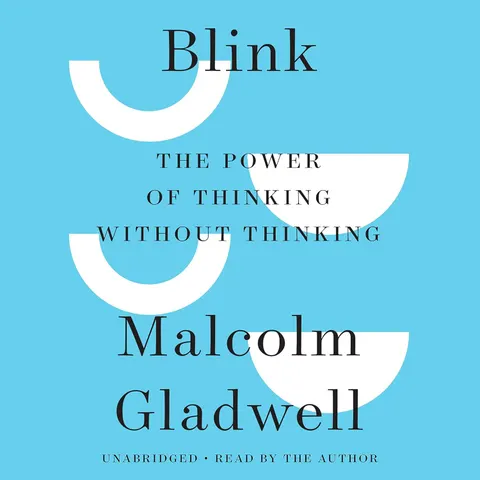
Cover of Blink: The Power of Thinking Without Thinking
Psychology & decisions

Blink: The Power of Thinking Without Thinking

inteligencia intuitiva por qué sabemos la verdad en dos segundos?

★★★★☆ No ratings 1 min read

Malcolm Gladwell is not a scientist, but he reads science well and turns it into compelling narrative.

Affiliate CTA preview · enabled with monetization (phase 5).

Gladwell explores the phenomenon of instant decisions: how in two seconds the expert brain can process more relevant information than weeks of deliberate analysis. The book examines when to trust intuition (when trained by years of experience) and when not to (when contaminated by bias or irrelevant information).

Our review

Malcolm Gladwell is not a scientist, but he reads science well and turns it into compelling narrative. «Blink», published in 2005, builds its argument on an appealing premise: the human brain can process enormous amounts of information unconsciously and produce rapid judgments — what Gladwell calls «thin-slicing» — that sometimes outperform extended deliberate analysis. He illustrates this with memorable cases: the art expert who detects a forgery in seconds, the police officer who makes split-second life-or-death decisions, the therapist who predicts a couple's divorce after hearing fifteen minutes of conversation. The problem is the inverse thesis: the book also includes cases where intuition fails spectacularly, and Gladwell does not always resolve satisfactorily when to trust instinct and when not to. Its relevance to financial decision-making is indirect: Gladwell does not write about investing, and extrapolating «trust your gut» to markets would be a risky reading. Where the book does add value is in showing that unconscious biases — including racial and gender biases — quietly contaminate many ostensibly rational decisions. It is a map-widening book, not an operational guide.

Who it's for

For professionals who make decisions under pressure and want to understand the role of expert judgment; those seeking a structured financial decision framework should look elsewhere.

Key takeaways

  • Thin-slicing works best in domains where the expert has accumulated thousands of hours of deliberate practice.
  • Intuition can be as reliable as deliberate analysis, but only when it draws on genuine accumulated experience rather than prejudice or insufficient data.
  • Unconscious biases distort judgments we believe to be objective; making them explicit is the first step toward mitigating them.
  • The speed of a decision is not an indicator of its quality: fast decisions can be brilliant or catastrophic depending on the conditions.
Fact

«Blink» was published in 2005 and sold over five million copies worldwide in its first decade, reaching number one on the New York Times bestseller list.

Topics Malcolm Gladwellintuicióndecisiones rápidasexperienciasesgos