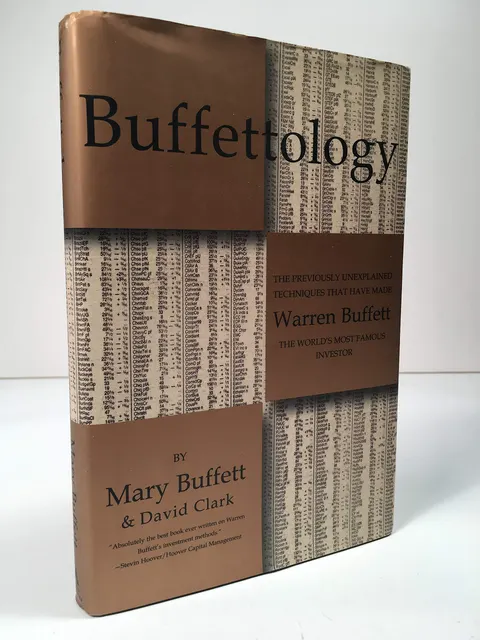
Cover of Buffettology
Stock investing

Buffettology

★★★★½ No ratings 1 min read

«Buffettology» is one of the most serious attempts to codify Warren Buffett's analytical method into a replicable step-by-step process.

Affiliate CTA preview · enabled with monetization (phase 5).

Mary Buffett, Warren Buffett's former daughter-in-law, reveals the exact method the Oracle of Omaha uses to select investments. Buffettology breaks down the analysis process step by step, with worksheets and numerical examples to evaluate any publicly traded company.

Our review

«Buffettology» is one of the most serious attempts to codify Warren Buffett's analytical method into a replicable step-by-step process. Mary Buffett, who had twelve years of direct access to the investor's family and circle, and David Clark break down Buffett's company selection process with a level of detail that the shareholder letters do not explicitly provide. The book is organized around a set of quantitative and qualitative criteria: sustained return on equity, predictable earnings growth, pricing power, absence of significant debt, and management that is honest with shareholders. The most practical tool the book offers is a spreadsheet framework for calculating intrinsic value using earnings-per-share projections and expected return rates. The most frequent critique is that the book presents the process as more mechanical than it probably is — Buffett himself has acknowledged that qualitative judgment is not quantifiable. Even so, for the investor who wants a structured Buffettian analysis framework, it is one of the most useful starting points available.

Who it's for

For investors with fundamental analysis knowledge who want to apply a quantitative framework inspired by Buffett; requires comfort with basic financial ratios.

Key takeaways

  • Sustained return on equity (ROE) over several years is one of the best indicators of a real competitive advantage.
  • Predictability of earnings growth is more valuable than growth itself: it allows intrinsic value to be calculated with a smaller margin of error.
  • Buffett treats investing in stocks as buying a business, not speculating on price movements.
  • The purchase price matters as much as business quality: an excellent company bought at too high a price can produce mediocre returns.
Fact

Published in 1997. Mary Buffett was Warren Buffett's daughter-in-law from 1981 until her divorce from Peter Buffett in 1993, during which time she had direct access to the investor's family circle.