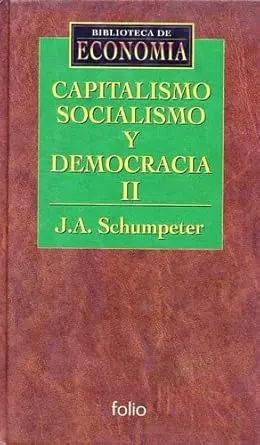
Cover of Capitalism, Socialism and Democracy
Classics & history

Capitalism, Socialism and Democracy

★★★★☆ No ratings 1 min read

«Capitalism, Socialism and Democracy» (1942) is Schumpeter's most ambitious work and one of the most paradoxical in the history of economic thought: a deeply conservative economist arguing that capitalism is doomed to collapse — not because of its failures but because of its successes.

Affiliate CTA preview · enabled with monetization (phase 5).

Schumpeter's masterwork contains two of the 20th century's most influential economics concepts: "creative destruction" — how capitalism constantly renews itself by destroying old structures to make way for new ones — and the Schumpeterian paradox, whereby capitalism sows the seeds of its own destruction by creating an intellectual class that critiques it.

Our review

«Capitalism, Socialism and Democracy» (1942) is Schumpeter's most ambitious work and one of the most paradoxical in the history of economic thought: a deeply conservative economist arguing that capitalism is doomed to collapse — not because of its failures but because of its successes. The book contains two contributions that remain central to contemporary economic debate. The first is the concept of «creative destruction»: the process by which capitalism constantly renews itself by destroying old structures to create new ones — the engine of innovation but also a source of permanent instability. The second is the analysis of democracy as a system: Schumpeter rejects the classical theory — the rational citizen choosing the common good — and proposes an elitist, procedural definition in which democracy is simply the mechanism by which parties compete for votes. The book's central thesis — that capitalism generates a stratum of intellectuals who criticise it and ultimately undermine its own institutions — is uncomfortable for any point on the political spectrum. The writing is dense but brilliant, and the book richly rewards readers who reach Parts III and IV.

Who it's for

Essential for economists, political scientists, and any serious reader interested in the theory of capitalism, democracy, and innovation; accessible to readers with a social science background, though it demands concentration.

Key takeaways

  • «Creative destruction» is capitalism's engine: innovation is not a complement to the system — it is the survival mechanism and the source of its instability.
  • Schumpeter argues that capitalism might collapse not from its crises but from the success that generates an intellectual class that erodes it from within.
  • Democracy is not the expression of the general will — it is a competitive mechanism for selecting political leadership.
  • The tension between disruptive innovation and institutional stability that Schumpeter identified in 1942 remains one of the great dilemmas of contemporary capitalism.
Fact

«Capitalism, Socialism and Democracy» was published in 1942 by Harper & Brothers in New York; the term «creative destruction», popularised by Schumpeter though with antecedents in Marx and Werner Sombart, is one of the most cited concepts in 20th-century economics and innovation theory.

Topics Schumpeterdestrucción creativacapitalismoinnovaciónclásico económico