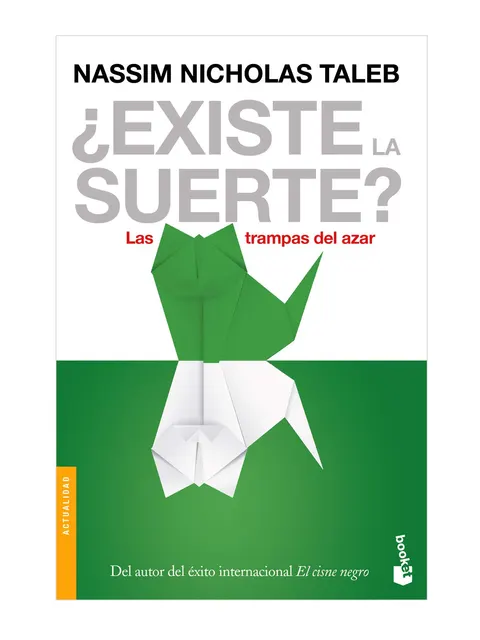
Cover of Fooled by Randomness
Psychology & decisions

Fooled by Randomness

Las trampas del azar

★★★★½ 10.0/10 (1) 1 min read

«Fooled by Randomness» is the first book in Nassim Nicholas Taleb's Incerto series and, arguably, the most accessible of them all.

Affiliate CTA preview · enabled with monetization (phase 5).

The first and most accessible book in Taleb's Incerto series. Taleb argues that humans systematically confuse skill with luck, and that financial markets are a domain where randomness is far greater than participants believe. Through anecdotes, literature, and probability, he shows that "talented" traders are often simply lucky survivors of the market's random roulette.

Our review

«Fooled by Randomness» is the first book in Nassim Nicholas Taleb's Incerto series and, arguably, the most accessible of them all. Published in 2001 and revised in later editions, the book develops a proposition that is deeply uncomfortable for anyone participating in financial markets: human beings are systematically unable to distinguish skill from luck, and environments with high randomness — such as financial markets — amplify that inability to dangerous extremes. Taleb illustrates his argument with examples of traders and fund managers who built brilliant track records over years before suffering sudden collapses that statistics made entirely predictable. The book introduces concepts he develops further in «The Black Swan» and «Antifragile»: the problem of induction, alternative history (paths not taken), and survivorship bias. The style is polemical, erudite, and occasionally maddening, but the density of ideas is genuinely high. This is not an easy or comfortable book; it is one that disturbs certainties.

Who it's for

For investors, traders, and any reader who wants to understand the limits of historical analysis and the pervasiveness of randomness in financial markets.

Key takeaways

  • Survivorship bias means we only see successful trajectories; those that failed with the same strategy are invisible yet statistically the majority.
  • A positive performance record in highly random environments tells us very little about the manager's actual skill.
  • Alternative history — the possible worlds that did not occur — is as relevant for evaluating a decision as the actual outcome.
  • Risk models calibrated on historical data are systematically blind to events that have not yet happened.
Fact

«Fooled by Randomness» was first published in 2001 and was selected by Fortune magazine as one of the smartest business books ever written.

Topics Talebaleatoriedadsuertesesgo del supervivienteprobabilidad