Macroeconomics
Summary and review ofFlash Boys
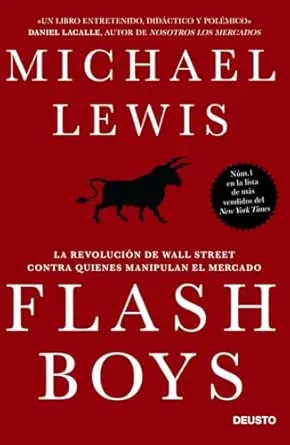
«Flash Boys» is first-rate financial journalism.
1 min read
View on Amazon
Amazon affiliate link. If you purchase through this link we earn a small commission at no extra cost to you.
«Flash Boys» is first-rate financial journalism.
Amazon affiliate link. If you purchase through this link we earn a small commission at no extra cost to you.
Michael Lewis reveals how high-frequency trading has turned financial markets into a system where the fastest algorithms extract rent from ordinary investors millisecond by millisecond, told through Brad Katsuyama's attempt to build a fair stock exchange.
«Flash Boys» is first-rate financial journalism. Michael Lewis builds a non-fiction narrative around Brad Katsuyama, an RBC trader who discovered that his stock orders always arrived late because high-frequency trading algorithms front-ran them by milliseconds — buying ahead of him and selling back at worse prices. From that personal story, Lewis opens a broader investigation into how high-frequency trading has transformed the structure of financial markets, fragmenting them across dozens of exchanges and venues where faster participants systematically extract value from slower ones. The book's thesis — that US stock markets are «rigged» in favor of HFT firms — generated considerable controversy upon publication in 2014 and was challenged by economists who argued that HFT also provides liquidity and narrows spreads. Lewis writes from Katsuyama's perspective, which gives the narrative coherence but limits analytical balance. As a description of market microstructure for non-specialist readers, it is unmatched. As a balanced assessment of HFT's costs and benefits, it needs to be supplemented with academic literature.
For those who want to understand how modern stock market microstructure works through a real story; not a balanced academic analysis of high-frequency trading.
Fact«Flash Boys» was published in 2014; IEX, founded by Brad Katsuyama with institutional investor backing, received SEC approval as an official exchange in 2016.