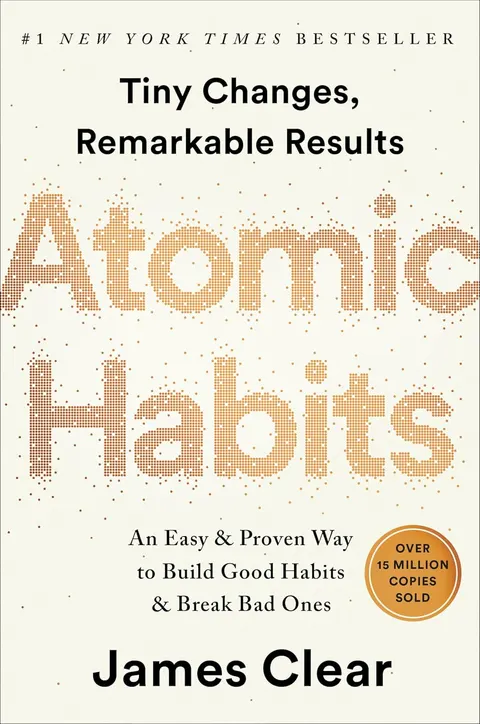
Cover of Atomic Habits
Bestseller
Psychology & decisions

Atomic Habits

An Easy & Proven Way to Build Good Habits & Break Bad Ones

★★★★½ 7.0/10 (7) 1 min read

«Atomic Habits» is not a personal finance book in the strict sense, but it may be more useful for a reader's financial outcomes than many investment manuals: James Clear, published in 2018, builds a system for understanding how behaviors are installed, maintained, and changed, with direct implications for economic discipline.

Affiliate CTA preview · enabled with monetization (phase 5).

James Clear argues that success comes from tiny 1% improvements sustained over time. His habit-building system — based on identity, cues, cravings, responses, and rewards — directly applies to financial discipline: automating savings, consistent investing, and eliminating wealth-sabotaging behaviors.

Our review

«Atomic Habits» is not a personal finance book in the strict sense, but it may be more useful for a reader's financial outcomes than many investment manuals: James Clear, published in 2018, builds a system for understanding how behaviors are installed, maintained, and changed, with direct implications for economic discipline. The central thesis is that great results do not emerge from great decisions but from the accumulation of small improvements — Clear uses 1% as the minimum unit — repeated over time. The system he proposes has four components: cue (making the habit obvious), craving (making it attractive), response (making it easy), and reward (making it satisfying). Applied to financial discipline, this means automating saving and investing before money is visible in a current account, associating saving with positive identities («I am someone who invests on the first of the month»), and reducing friction around desired behaviors. Clear does not address specific financial products and the book has been criticized for oversimplifying habit formation in high-adversity contexts. Even so, as a behavioral design tool applied to personal finance, it has few rivals in accessibility.

Who it's for

For those who are clear on what they should do with their money but struggle to maintain consistency; this is not a book about what to invest in but about how to build the habit of doing it.

Key takeaways

  • Automating contributions to savings and investments eliminates the friction of daily decision-making and makes the system work without constant willpower.
  • Identity («I am an investor») is a more durable motivator than goals («I want to save X euros»).
  • Sustained 1% improvements over years produce disproportionately greater results than sporadic efforts.
  • Reducing friction around desired habits — making investing the easiest option — is as effective as increasing motivation.
Fact

«Atomic Habits» was published in 2018; the title refers to the double meaning of «atomic» — something small and irreducible, but also the unit that, combined, generates energy.

Topics hábitosJames Cleardisciplinamejora continuasistema