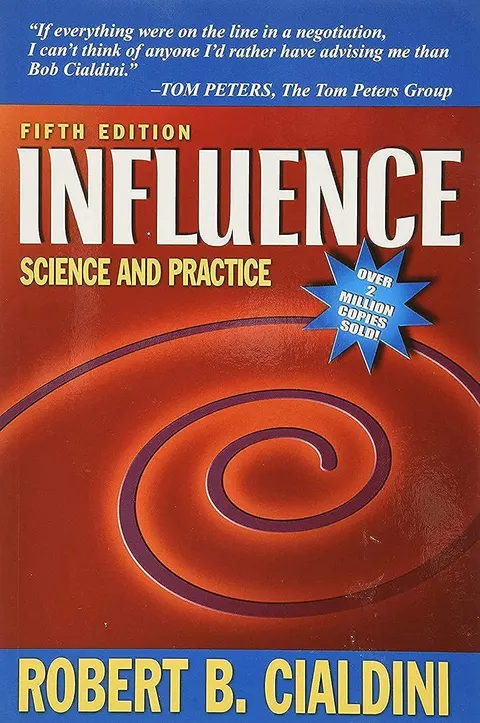
Cover of Influence: The Psychology of Persuasion
Bestseller
Psychology & decisions

Influence: The Psychology of Persuasion

The Psychology of Persuasion

★★★★½ No ratings 1 min read

Robert Cialdini published in 1984 the result of three years of undercover research in sales, advertising, and negotiation environments, and the resulting book remains the most cited reference on the psychological mechanisms of persuasion.

Affiliate CTA preview · enabled with monetization (phase 5).

The most influential book ever written on the psychology of persuasion. Cialdini identifies six universal principles governing compliance decisions: reciprocity, commitment and consistency, social proof, authority, liking, and scarcity. For investors, a defense manual against financial salespeople, media, and crowd behavior exploiting mental shortcuts.

Our review

Robert Cialdini published in 1984 the result of three years of undercover research in sales, advertising, and negotiation environments, and the resulting book remains the most cited reference on the psychological mechanisms of persuasion. The six principles he describes — reciprocity, commitment and consistency, social proof, authority, liking, and scarcity — are not marketing tricks but evolutionary cognitive patterns that skilled persuaders exploit systematically. The book's value is twofold: it explains each principle with real experiments and concrete examples, and in doing so turns the reader into a far more effective detector of influence. The most honest limitation is that the original research is four decades old and some of the studies cited belong to an era of lower rigor in the replicability of social sciences. The 2021 edition adds a seventh principle (unity, or a sense of shared identity), which partially updates the framework. For investors, the book is particularly relevant because many of the cognitive errors it describes are identical to those that lead to buying at peaks or following recommendations from sources with conflicts of interest.

Who it's for

For any professional who negotiates, sells, or makes decisions under external influence; also valuable for investors who want to identify when they are being manipulated.

Key takeaways

  • The six principles of influence (reciprocity, commitment, social proof, authority, liking, scarcity) operate automatically and subconsciously.
  • Understanding persuasion principles makes you a harder target for those who use them with manipulative intent.
  • Social proof is especially powerful in situations of uncertainty — exactly when independent judgment is most needed.
  • Public commitment increases future behavioral consistency, which can be used for good or for manipulation.
Fact

Published in 1984, Influence has sold more than five million copies worldwide and is a reference text in MBA programs at numerous international business schools.

Topics Robert Cialdinipersuasiónreciprocidadprueba socialautoridad