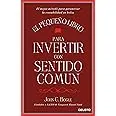
Cover of The Little Book of Common Sense Investing
Bestseller
Stock investing

The Little Book of Common Sense Investing

El mejor método para garantizar la rentabilidad en bolsa

★★★★½ No ratings 1 min read

«The Little Book of Common Sense Investing» is the most concentrated and accessible argument John Bogle ever made for index investing: unlike his major work «Common Sense on Mutual Funds», this volume of just over 200 pages is designed for the reader without financial training who needs the «why» without the full technical apparatus.

Affiliate CTA preview · enabled with monetization (phase 5).

John Bogle, Vanguard's founder and godfather of index funds, makes the mathematically elegant case for passive investing: after costs, the average active investor must underperform the index. The only winning long-term strategy is to buy the whole market, hold it forever, and minimize costs.

Our review

«The Little Book of Common Sense Investing» is the most concentrated and accessible argument John Bogle ever made for index investing: unlike his major work «Common Sense on Mutual Funds», this volume of just over 200 pages is designed for the reader without financial training who needs the «why» without the full technical apparatus. Published in 2007, Bogle uses a single equation as the book's axis: the return earned by all stock market investors in aggregate is exactly the return of the business — dividends plus earnings growth — minus intermediation costs. It follows that any strategy minimizing costs to the lowest level — such as index funds — has a mathematical advantage over any strategy that increases them. The book also devotes chapters to dismantling the most widespread myths: that past high-performing active funds are likely to repeat, that star managers are more predictable than statistics suggest, and that portfolio complexity signals sophistication. Bogle does not propose a specific portfolio but does offer construction principles: total diversification, minimum cost, long horizon, and absence of unnecessary turnover. For those who have already read Collins or Malkiel, this book adds little. For those starting out, it is an efficient entry point.

Who it's for

For the beginning or intermediate investor who wants the passive investing case explained clearly and briefly.

Key takeaways

  • The investor's net return equals the market's gross return minus total costs: reducing costs is the only guaranteed lever.
  • Active fund past performance has little predictive power over future performance relative to the index.
  • The simplicity of an indexed portfolio is not a concession to unsophistication but the consequence of understanding how markets work.
  • Frequent portfolio turnover generates tax and transaction costs that erode returns without demonstrable compensation.
Fact

Published in 2007, thirty-one years after Bogle launched the first index fund at Vanguard in 1976, this book is a synthesis of his entire investment philosophy in accessible format.