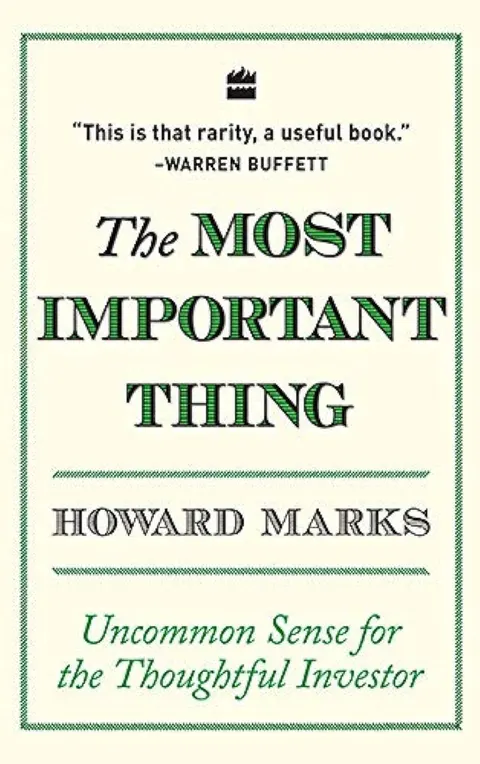
The Most Important Thing
Uncommon Sense for the Thoughtful Investor
Howard Marks has spent decades writing investment memos that the world's best fund managers read with devoted attention.
Affiliate CTA preview · enabled with monetization (phase 5).
Uncommon Sense for the Thoughtful Investor
Howard Marks has spent decades writing investment memos that the world's best fund managers read with devoted attention.
Affiliate CTA preview · enabled with monetization (phase 5).
Howard Marks, co-founder of Oaktree Capital, distils his investment philosophy into seventeen "most important" concepts: second-level thinking, understanding market cycles, risk, luck, and skill. Essential reading for understanding risk management and market cycles.
Howard Marks has spent decades writing investment memos that the world's best fund managers read with devoted attention. «The Most Important Thing» distils that intellectual output into a single volume, organized around seventeen «most important» concepts — second-level thinking, understanding risk, market cycles, investor psychology — that Marks considers indispensable for sound investing. The underlying thesis is that markets are efficient enough to make beating them difficult, but imperfect enough to make it possible with second-level thinking: not asking whether a company is good, but whether the market is pricing it correctly given what everyone already knows. The treatment of risk is the book's most original chapter: Marks argues that risk is not volatility — the academic definition — but the possibility of permanent capital loss, and that this risk increases when prices rise, not when they fall. The annotated edition incorporates notes from Buffett, Klarman, and others, adding layers of perspective without increasing complexity.
For experienced equity investors who want to deepen their conceptual framework on risk, cycles, and market psychology; this is not an introductory book.
FactHoward Marks is co-founder of Oaktree Capital Management, which manages assets of over $150 billion. The book was published in 2011.