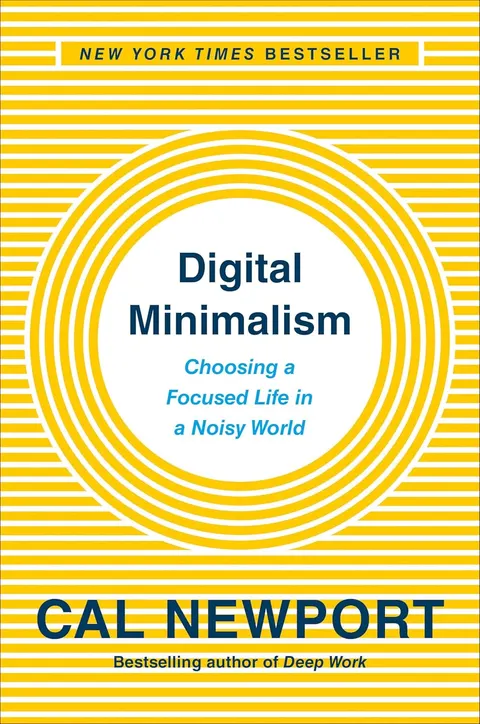
Cover of Digital Minimalism: Choosing a Focused Life in a Noisy World
Strategy & life

Digital Minimalism: Choosing a Focused Life in a Noisy World

en defensa de la atención en un mund ruidoso

★★★★☆ No ratings 1 min read

Cal Newport does not write about switching off your phone — he writes about reclaiming sovereignty over your own time.

Affiliate CTA preview · enabled with monetization (phase 5).

Newport proposes a philosophy of intentional technology use: not giving it up, but deliberately choosing which digital tools deserve a place in our lives. For investors, the mental clarity from a sparse digital environment translates to better decisions and less reactivity to market noise.

Our review

Cal Newport does not write about switching off your phone — he writes about reclaiming sovereignty over your own time. «Digital Minimalism» opens from an uncomfortable premise: that most apps we use daily were not built to serve us but to capture and monetise our attention. From there, Newport builds a philosophy of intentional technology use, proposing a thirty-day social media detox not as the destination but as a diagnostic tool, after which users reintroduce only the tools whose value clearly outweighs their cost in autonomy and focus. The book balances philosophical argument (Thoreau, Stoicism) with first-hand accounts from practitioners of the method, making it rigorous without becoming academic. The honest caveat is that Newport's prescription is most accessible to knowledge workers who enjoy schedule flexibility; those whose livelihoods depend on digital platforms will find the advice harder to operationalise. For investors and anyone who manages capital, the central argument — that attentional fragmentation erodes the quality of long-term thinking — has direct implications for decision-making under uncertainty.

Who it's for

Best suited to professionals who feel that digital distraction is undermining their analytical focus; less relevant for readers who already maintain tight boundaries around technology use.

Key takeaways

  • Digital tools are not neutral: every app is engineered to maximise time-on-platform, not the value you extract from it.
  • The 30-day experiment is a diagnostic for clarity, not a permanent vow of digital abstinence.
  • Deep thinking requires uninterrupted time blocks — something constant connectivity makes structurally difficult to achieve.
  • Reintroducing a digital tool should be a deliberate decision, never an accidental relapse.
Fact

Published in 2019, the book spent over a year on the New York Times non-fiction bestseller list.