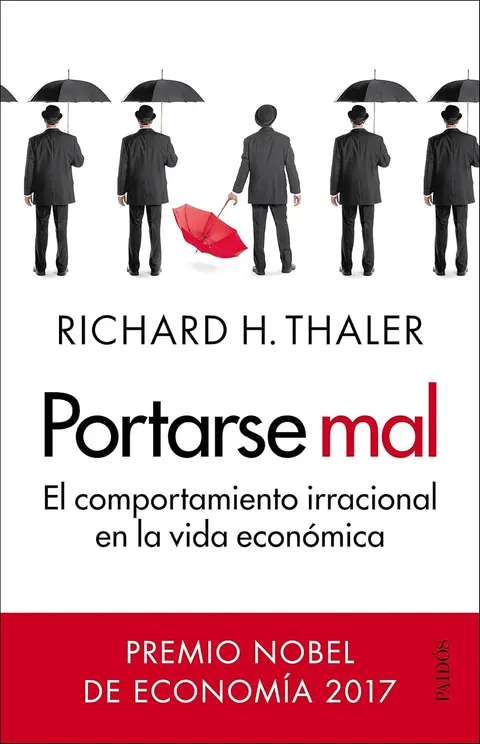
Cover of Misbehaving
Psychology & decisions

Misbehaving

★★★★☆ No ratings 1 min read

«Misbehaving» (2015) is an unusual intellectual autobiography: Richard Thaler narrates the birth and consolidation of behavioural economics as an academic discipline from the inside, as one of its founders.

Affiliate CTA preview · enabled with monetization (phase 5).

Richard Thaler's intellectual autobiography is also the story of behavioral economics as a discipline. He narrates how he built, alongside Kahneman, Tversky, and others, the behavioral economics edifice: prospect theory, mental accounting, endowment effect, present bias — all demonstrating that humans are not the rational agents standard economics assumes.

Our review

«Misbehaving» (2015) is an unusual intellectual autobiography: Richard Thaler narrates the birth and consolidation of behavioural economics as an academic discipline from the inside, as one of its founders. The book covers four decades of research, from Thaler's early years at Rochester — when colleagues viewed his questioning of the rational-agent axiom with open scepticism — to the global recognition of behavioural economics as a legitimate field. Along the way, Thaler describes his collaborations with Daniel Kahneman and Amos Tversky, the formulation of concepts such as mental accounting, the endowment effect, and regression to the mean, and how these findings were gradually absorbed into economic policy. The writing is accessible and wry, with the humour of someone who enjoyed decades of institutional scepticism before vindication. For readers who already know «Nudge» or «Thinking, Fast and Slow», this book adds the backstory: who proposed these ideas, how they were validated, and why orthodox economics resisted them for so long.

Who it's for

For readers who already know the foundations of behavioural economics and want to understand its intellectual history from the perspective of one of its creators.

Key takeaways

  • Behavioural economics was born from observing that real people systematically «misbehave» according to rational-agent models.
  • The endowment effect explains why we value what we own more than an equivalent we do not: an anomaly with deep implications in finance and investing.
  • Mental accounting — treating money differently based on its source or intended use — generates predictable, suboptimal financial decisions.
  • Institutionalising a new idea requires decades of accumulated evidence, precise language, and allies within the system willing to advocate for it.
Fact

Richard Thaler published «Misbehaving» in 2015; two years later, in 2017, he received the Nobel Prize in Economics for his contributions to behavioural economics.

Topics Richard Thalereconomía conductualcontabilidad mentalefecto dotaciónNobel