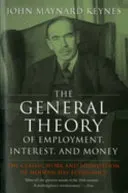
The General Theory of Employment, Interest and Money
Keynes's «General Theory» is the most influential economics book of the 20th century and, possibly, the most difficult to read.
Affiliate CTA preview · enabled with monetization (phase 5).
Keynes's «General Theory» is the most influential economics book of the 20th century and, possibly, the most difficult to read.
Affiliate CTA preview · enabled with monetization (phase 5).
The work that changed modern macroeconomics. Published in 1936 in response to the Great Depression, Keynes argues that markets alone cannot guarantee full employment: in demand collapse, state intervention through public spending is needed to restore activity. His concepts — aggregate demand, fiscal multiplier, liquidity trap, and investor "animal spirits" — remain the reference framework for economic policy worldwide.
Keynes's «General Theory» is the most influential economics book of the 20th century and, possibly, the most difficult to read. Published in 1936 at the height of the Great Depression, it was conceived as a demolishing critique of neoclassical economics and its postulate that free markets naturally tend toward full employment. Keynes argues that markets can become trapped in equilibria with mass unemployment for prolonged periods, and that in those circumstances state intervention — through public spending that stimulates aggregate demand — is not only legitimate but necessary. The concepts it introduces — the liquidity trap, the marginal efficiency of capital, the fiscal multiplier, liquidity preference — redefined the vocabulary of modern macroeconomics. A fair critique: Keynes's writing is notoriously dense and at times obscure, giving rise to decades of divergent interpretations of what the book «really says». Keynes himself acknowledged he was wrestling with his own ideas as he wrote. To read the «General Theory» productively, it helps to have a Keynesian macroeconomics textbook as a guide, or to start with the syntheses offered by Hicks or Samuelson.
Required reading for economists, historians of economic thought, and postgraduate economics students; readers without a macroeconomics background should start with a synthesis before approaching the original text.
FactThe «General Theory of Employment, Interest and Money» was published on 4 February 1936 by Macmillan in London; the first print run of 5,000 copies sold out within days, and the book has been translated into more than 30 languages.