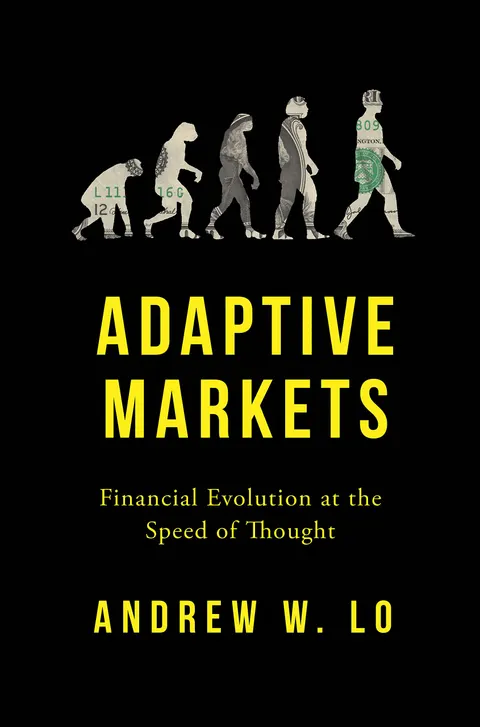
Cover of Adaptive Markets: Financial Evolution at the Speed of Thought
English only

Adaptive Markets: Financial Evolution at the Speed of Thought

Financial Evolution at the Speed of Thought

★★★★☆ No ratings 1 min read

Adaptive Markets represents one of the most serious attempts in recent decades to reconcile two opposing traditions in financial theory: Eugene Fama's efficient markets hypothesis and the behavioral finance of Kahneman and Thaler.

Affiliate CTA preview · enabled with monetization (phase 5).

MIT economist Andrew Lo proposes the "Adaptive Markets Hypothesis": a synthesis of efficient markets and behavioral psychology that better explains financial reality. Markets are neither perfectly efficient nor fully irrational — they evolve adaptively like biological systems. A major intellectual contribution for understanding 21st-century markets.

Our review

Adaptive Markets represents one of the most serious attempts in recent decades to reconcile two opposing traditions in financial theory: Eugene Fama's efficient markets hypothesis and the behavioral finance of Kahneman and Thaler. Andrew Lo, MIT economist and director of the Laboratory for Financial Engineering, proposes the «Adaptive Markets Hypothesis»: markets are neither permanently efficient nor irrationally chaotic but evolve through a process analogous to natural selection. Investors learn, adapt to their environment, and make predictable mistakes when conditions change faster than their ability to adjust. The book is ambitious in scope — spanning neuroscience, financial regulation, and the 2008 crisis — and is written with narrative accessibility unusual for a work of this theoretical depth. The main limitation is that the theory, while persuasive as a conceptual framework, still lacks the precise empirical tools needed for rigorous falsifiability. That said, it is arguably the most influential book of the past decade in financial market theory.

Who it's for

Recommended for readers interested in financial theory and behavioral economics who want to move beyond standard frameworks; requires some familiarity with academic debates on market efficiency.

Key takeaways

  • The Adaptive Markets Hypothesis proposes that markets evolve through a process analogous to natural selection: strategies that work get replicated until they stop working.
  • Investor errors are not random — they are predictable and systematic when the environment changes faster than participants can adapt.
  • Market efficiency is not a constant but a variable that fluctuates with competitive conditions, liquidity, and the speed of institutional change.
  • The 2008 financial crisis is analyzed in the book as a collective adaptation failure, not simply a consequence of individual irrationality or greed.
Fact

Andrew W. Lo is a professor at MIT Sloan School of Management and director of the MIT Laboratory for Financial Engineering; Adaptive Markets was published in 2017 by Princeton University Press.

Topics market theoryadaptive marketsbehavioral financeefficient marketsevolution