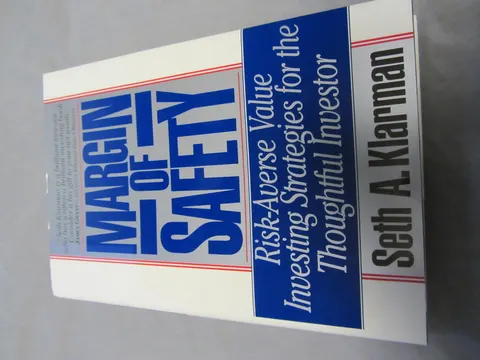
Cover of Margin of Safety: Risk-Averse Value Investing Strategies for the Thoughtful Investor
Bestseller
English only

Margin of Safety: Risk-Averse Value Investing Strategies for the Thoughtful Investor

Risk-averse Value Investing Strategies for the Thoughtful Investor

★★★★½ 9.0/10 (7) 1 min read

Seth Klarman wrote this book in 1991 as a philosophical clarification of conservative value investing, and it has since become a cult object: the original edition sells in the secondary market for thousands of dollars because it was never reprinted.

Affiliate CTA preview · enabled with monetization (phase 5).

The most sought-after and scarce book in investing. Seth Klarman, founder of Baupost Group, lays out his conservative value investing philosophy focused on capital preservation and finding undervalued assets with a wide margin of safety. Published in 1991 and never reprinted, original copies sell for hundreds of dollars — essential reading for any serious value investor.

Our review

Seth Klarman wrote this book in 1991 as a philosophical clarification of conservative value investing, and it has since become a cult object: the original edition sells in the secondary market for thousands of dollars because it was never reprinted. That fact alone reveals something about the nature of the book — it was not designed for mass consumption but for the investor who thinks with rigor and patience. The central thesis is the one that gives the book its title: the margin of safety, the principle articulated by Benjamin Graham holding that you should only purchase an asset when its market price offers a significant discount to its estimated intrinsic value, thereby protecting against analytical error and the inevitable uncertainty of the future. Klarman expands that principle into an articulate critique of modern financial markets: fund management that chases the benchmark rather than real value, institutionalized short-termism, and the incentive structures that distort analyst and manager behavior. The text is dense and demands the reader; there are no pedagogical concessions. Its limitation, if there is one, is that the analytical framework was written before technology companies, platforms, and network economies made estimating intrinsic value with traditional tools considerably more difficult.

Who it's for

For serious investors with solid financial training who want to understand the philosophical principles of conservative value investing; not appropriate for beginners.

Key takeaways

  • The margin of safety is the gap between the price paid and estimated intrinsic value — that gap is the protection against error and uncertainty.
  • Real risk is not price volatility but permanent loss of capital, a distinction that radically changes how investments should be analyzed.
  • Most institutional investors are structurally incentivized not to practice genuine value investing — their time horizons and benchmarks work against it.
  • The discipline of not acting — waiting for an opportunity with a real margin of safety — is more difficult and more valuable than finding good ideas.
Fact

Published in 1991, Margin of Safety was never reprinted and original copies have sold in secondary markets for prices exceeding 2,000 dollars.

Topics value investingSeth Klarmanmargin of safetyrisk managementcapital preservation