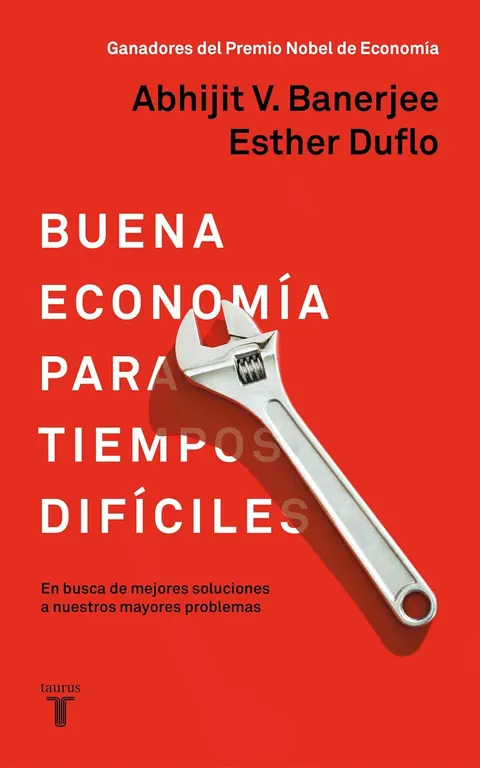
Cover of Good Economics for Hard Times
Macroeconomics

Good Economics for Hard Times

★★★★☆ No ratings 1 min read

«Good Economics for Hard Times» arrives with an unusual credential: its authors, Abhijit Banerjee and Esther Duflo, received the Nobel Prize in Economics in 2019, the same year of publication.

Affiliate CTA preview · enabled with monetization (phase 5).

The 2019 Nobel Prize economists apply experimental rigour to the great problems of our time — immigration, trade, climate, inequality, automation — defending evidence-based solutions over populism. An accessible, profound book showing how good economics can improve the world without easy recipes or ideology.

Our review

«Good Economics for Hard Times» arrives with an unusual credential: its authors, Abhijit Banerjee and Esther Duflo, received the Nobel Prize in Economics in 2019, the same year of publication. The book is not a superficial popularisation — it is an honest, nuanced review of what experimental economics knows, and does not know, about the great debates of our time: immigration, free trade, inequality, climate change, and automation. Banerjee and Duflo apply the same evidentiary standards to the dogmas of the economic right and left alike, making the book uncomfortable for readers seeking confirmation of prior beliefs. The prose is direct and accessible without sacrificing rigour, with consistent references to randomised trials and field experiments. The main limitation is that the authors are more confident in their diagnoses than in their policy prescriptions, some of which are deliberately tentative. For investors interested in macroeconomics and in the structural forces shaping developed and emerging economies, this book offers a data-driven analytical framework in place of ideology.

Who it's for

Recommended for readers interested in applied economics and policy who want to understand current major debates through empirical evidence rather than ideology.

Key takeaways

  • Experimental economics has overturned many popular intuitions about immigration, trade, and inequality that persist in political debate.
  • Economic incentives are powerful but not omnipotent — human behaviour also responds to social norms and context.
  • Extreme inequality carries measurable economic costs, not just moral ones, affecting productivity and social cohesion.
  • Universal economic prescriptions rarely work — local context matters more than standard models typically admit.
Fact

Abhijit Banerjee and Esther Duflo received the Nobel Prize in Economics in October 2019, the same year the book was published.

Topics Nobel de Economíadesigualdadinmigracióncambio climáticoeconomía experimental