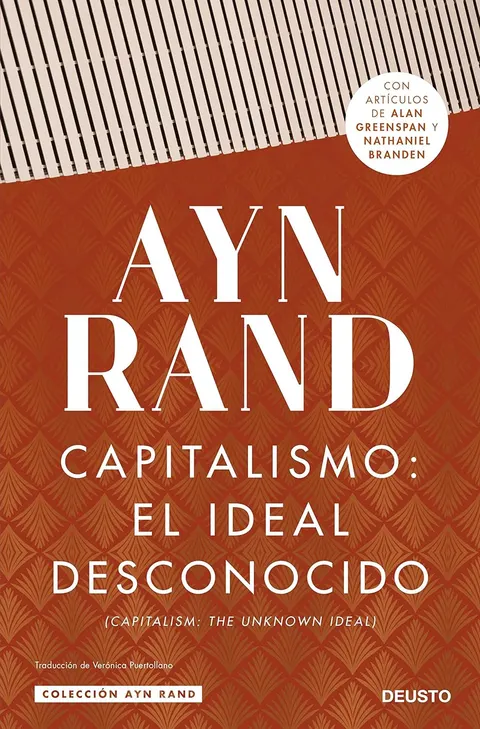
Cover of Capitalism: The Unknown Ideal
Macroeconomics

Capitalism: The Unknown Ideal

The Unknown Ideal (50th Anniversary Edition)

★★★★☆ No ratings 1 min read

«Capitalism: The Unknown Ideal», published in 1966, is Ayn Rand's most directly political work and the most rigorous exposition of the Objectivist philosophical program applied to economics and politics.

Affiliate CTA preview · enabled with monetization (phase 5).

A collection of essays by Ayn Rand, Nathaniel Branden, Alan Greenspan, and Robert Hessen defending laissez-faire capitalism not as pragmatic or efficient, but as the only social system consistent with human nature as rational beings. The most systematic treatment of Rand's economic politics.

Our review

«Capitalism: The Unknown Ideal», published in 1966, is Ayn Rand's most directly political work and the most rigorous exposition of the Objectivist philosophical program applied to economics and politics. The book is a collection of essays by Rand, Nathaniel Branden, Alan Greenspan — before his tenure as Federal Reserve chairman — and Robert Hessen, defending laissez-faire capitalism not as an efficient or pragmatic system, but as the only social system fully consistent with the rational nature of human beings and with the principle that individual rights are inviolable. The essays address antitrust law, money and the gold standard, intellectual property, and the relationship between capitalism and violence. Greenspan's contribution — a defense of the gold standard before he became a central banker — is particularly notable in retrospect. The book's principal limitation is the same as that of the entire Objectivist corpus: Rand's philosophical system is closed and does not engage with critics but dismisses them from within the premises. For understanding radical Anglo-American liberal thought in its most philosophical form, it is a useful if demanding reference.

Who it's for

For readers who want to understand Rand's Objectivism in its political and economic application, and the thinking that has influenced parts of the Anglo-American libertarian movement; less suited for those seeking pluralist debate.

Key takeaways

  • For Rand, laissez-faire capitalism is not one economic system among others: it is the logical consequence of recognizing individual rights as inviolable.
  • Antitrust legislation, in the authors' analysis, does not protect competition but distorts it by politicizing economic decisions.
  • Greenspan's essay defends the gold standard as the only mechanism preventing governments from financing public spending through monetary expansion.
  • The defense of intellectual property as a natural extension of property rights is one of the most developed and debated arguments in the collection.
Fact

«Capitalism: The Unknown Ideal» was published in 1966; co-author Alan Greenspan served as chairman of the U.S. Federal Reserve from 1987 to 2006 — a position that, from an Objectivist perspective, could be seen as a contradiction with his 1966 positions.

Topics Ayn Randobjetivismocapitalismo laissez-fairefilosofía políticaAlan Greenspan