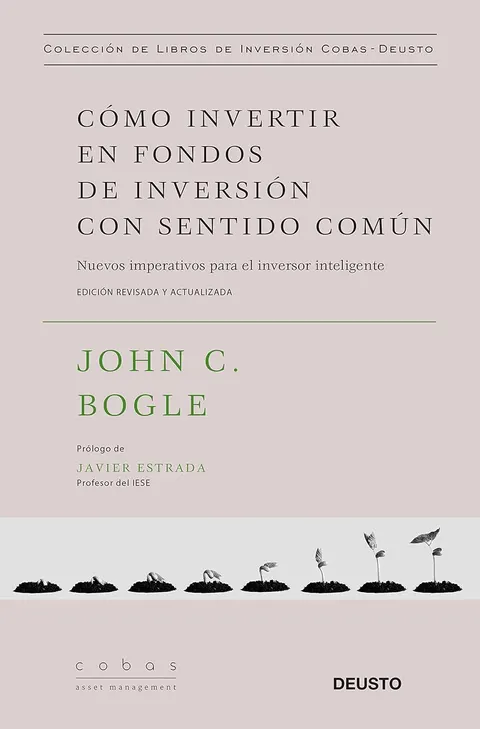
Cover of Common Sense on Mutual Funds
Bestseller
Index funds / FIRE

Common Sense on Mutual Funds

★★★★½ No ratings 1 min read

«Common Sense on Mutual Funds» is the most systematic and documented argument John Bogle — founder of Vanguard and creator of the first publicly accessible index fund in 1976 — assembled across his career.

Affiliate CTA preview · enabled with monetization (phase 5).

John C. Bogle, founder of Vanguard and inventor of the index fund for individual investors, lays out his investment philosophy: low costs, diversification, and patience. Bogle demonstrates with irrefutable data that most actively managed funds fail to beat the market after fees, and that passive investing in index funds is the most rational strategy for most investors.

Our review

«Common Sense on Mutual Funds» is the most systematic and documented argument John Bogle — founder of Vanguard and creator of the first publicly accessible index fund in 1976 — assembled across his career. Published in 1999, the book is structured as a formal indictment of the active management industry: Bogle demonstrates, with decades of data, that costs are the only reliable predictor of a fund's net return and that the vast majority of active managers not only fail to add value but actively destroy it. His central argument is arithmetic before it is philosophical: the aggregate of all market investors earns exactly the market return before costs and below it after. There is no mathematical way for all active managers to beat the index. What makes the text especially valuable is the density of empirical evidence it accumulates: data on equity, fixed-income, and hybrid funds across multiple cycles. Its main limitation is length — more than 400 pages in the complete edition — and some repetition of the core argument; readers who already know the basic thesis may find the pace slow. For those who want the complete data-backed argument, it has no equal.

Who it's for

For investors who want to understand the complete empirical case for index investing, not just the summary; readers seeking a quick guide should start with a different title.

Key takeaways

  • A fund's costs are the only factor that reliably predicts its future net performance relative to the market.
  • By pure arithmetic, active management as a whole cannot beat the market; some strategies win, but others lose exactly the same amount.
  • The return investors actually capture is below the fund's stated return because they buy and sell at the wrong times.
  • Total market diversification and long time horizons are the two risk antidotes an investor can actually control.
Fact

John Bogle launched the first index fund accessible to individual investors in 1976, more than two decades before publishing this book where he systematized the empirical evidence behind that decision.