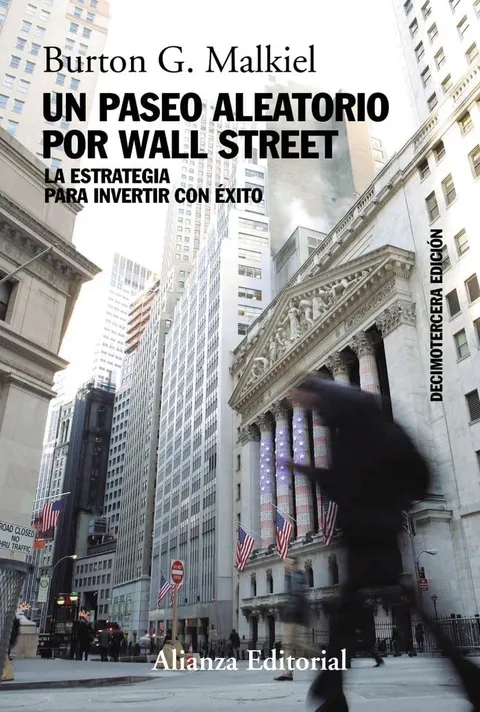
Cover of A Random Walk Down Wall Street
Bestseller
Index funds / FIRE

A Random Walk Down Wall Street

The Time-Tested Strategy for Successful Investing

★★★★½ No ratings 1 min read

«A Random Walk Down Wall Street» is one of the founding texts of modern passive investing: Princeton economist Burton G.

Affiliate CTA preview · enabled with monetization (phase 5).

Princeton economist Burton Malkiel develops the efficient market hypothesis in its most accessible form and demonstrates that no active manager can consistently beat the market after costs. A founding text of the passive investing movement, first published in 1973.

Our review

«A Random Walk Down Wall Street» is one of the founding texts of modern passive investing: Princeton economist Burton G. Malkiel published the first edition in 1973 with a thesis then considered scandalous by Wall Street — stock prices move so unpredictably that a chimpanzee throwing darts could outperform most professional managers. The «random walk» metaphor describes the practical impossibility of predicting the next price move from past ones. Malkiel exhaustively examines both technical and fundamental analysis and concludes that neither provides a systematic edge after costs once the market has absorbed available information. The book's strength is that it is academically rigorous and accessible to readers without an economics background: Malkiel balances efficient market theory with concrete historical cases — bubbles, manias, crashes — that ground the argument in reality. The most recent edition brings the text into the twenty-first century with chapters on cryptocurrencies and quantitative risk factors. The limitation the author himself acknowledges is that markets are not perfectly efficient, but they are efficient enough to make beating them structurally difficult.

Who it's for

For intellectually curious readers who want to understand from theoretical and historical foundations why passive investing works.

Key takeaways

  • Market prices incorporate available information so quickly that obtaining a systematic edge through analysis is extremely difficult.
  • Both technical and fundamental analysis have documented limitations when applied systematically over the long run.
  • Stock market bubbles are recurrent and obvious in hindsight but nearly impossible to time precisely from the inside.
  • Low-cost index fund investing is the strategy most consistent with the available empirical evidence on how markets behave.
Fact

First published in 1973, the book has been revised and expanded multiple times and stands as one of the investment manuals with the most updated editions in publishing history.

Topics mercado eficientefondos indexadosinversión pasivaMalkielPrinceton