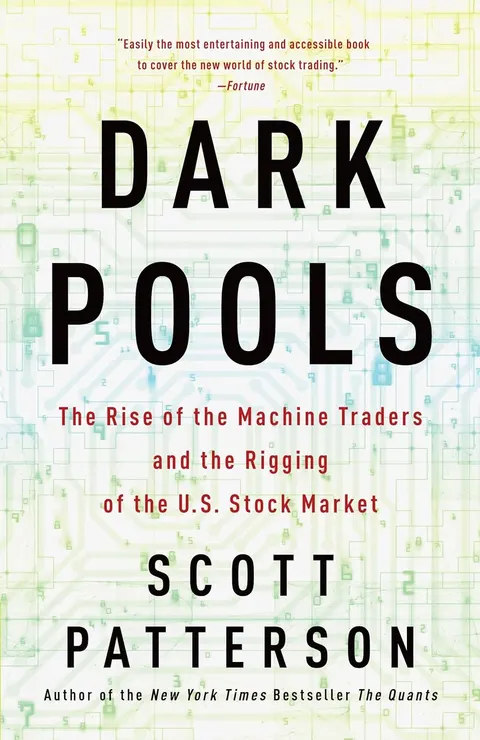
Cover of Dark Pools: High-Speed Traders, A.I. Bandits, and the Threat to the Global Financial System
English only

Dark Pools: High-Speed Traders, A.I. Bandits, and the Threat to the Global Financial System

High-Speed Traders, AI Bandits, and the Threat to the Global Financial System

★★★★☆ No ratings 1 min read

Dark Pools is a journalistic account of the most radical transformation in financial markets in a generation: the shift from physical trading floors and human specialists to an ecosystem dominated by high-frequency trading algorithms and opaque trading platforms operating outside regulated exchanges.

Affiliate CTA preview · enabled with monetization (phase 5).

Patterson narrates the rise of "dark pools" and high-frequency trading platforms operating outside traditional exchanges. He explores how algorithms have radically transformed financial markets, the risks this new ecosystem generates, and whether modern markets are truly fair — a perfect companion to Michael Lewis's Flash Boys.

Our review

Dark Pools is a journalistic account of the most radical transformation in financial markets in a generation: the shift from physical trading floors and human specialists to an ecosystem dominated by high-frequency trading algorithms and opaque trading platforms operating outside regulated exchanges. Scott Patterson, a Wall Street Journal reporter, tells this story through the people who built it: programmers, mathematicians, and financial engineers who during the 1990s and 2000s designed systems capable of executing thousands of trades per second, detecting price patterns in milliseconds, and — according to their critics — front-running institutional investors' orders before they are filled. The book raises questions about fairness, transparency, and the systemic stability of modern markets, though its tone is more narrative than analytical: Patterson does not offer precise regulatory proposals but documents in detail how this ecosystem was constructed. Published in 2012, some technical aspects have evolved, but the debate over dark pools and HFT remains fully open.

Who it's for

For any reader interested in the microstructure of modern financial markets and the history of algorithmic trading; accessible without prior technical knowledge.

Key takeaways

  • Dark pools are private trading platforms that allow large orders to be executed outside regulated exchanges, reducing market impact but decreasing market transparency.
  • High-frequency trading transformed markets in the 1990s and 2000s, compressing execution times from minutes to microseconds and changing the nature of liquidity.
  • Speed as a competitive advantage creates incentives to build infrastructure that prioritizes velocity over transparency and fairness.
  • The debate over whether HFT benefits or harms long-term investors remains unresolved and depends largely on which type of investor is taken as the reference point.
Fact

Dark Pools was published in 2012 by Scott Patterson, a Wall Street Journal reporter and also the author of The Quants (2010). The book primarily covers algorithmic trading developments between the 1990s and the early 2010s.

Topics dark poolshigh-frequency tradingalgorithmic tradingWall Streetmarket microstructure