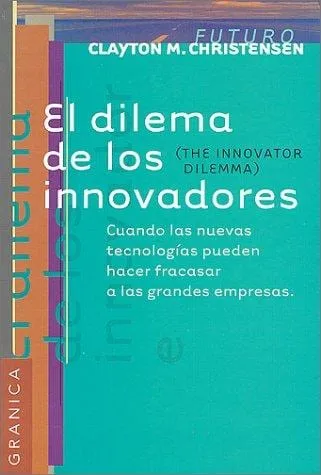
Cover of The Innovator's Dilemma
Business strategy

The Innovator's Dilemma

★★★★☆ No ratings 1 min read

Clayton Christensen started with an anomaly: in the disk drive industry, leading companies — well managed, customer-focused, profitable — lost their leadership at every technological transition, always to newcomers with initially worse products.

Affiliate CTA preview · enabled with monetization (phase 5).

Clayton Christensen solved one of the great business paradoxes: why the best-managed companies — the ones listening to customers and improving products — are precisely those that fall to disruptive technologies. The concept of «disruption» that defined recent decades of tech vocabulary was born in this book.

Our review

Clayton Christensen started with an anomaly: in the disk drive industry, leading companies — well managed, customer-focused, profitable — lost their leadership at every technological transition, always to newcomers with initially worse products. His explanation created a category of thought: disruptive innovation. Disruptive technologies start out inferior on the metrics mainstream customers value but superior on others (price, size, simplicity) that appeal to marginal customers; incumbents rationally dismiss them — their customers don't want them, their margins are worse — and by the time the technology improves enough to invade the mainstream, it is too late. The dilemma is genuine: doing «the right thing» by classic management is exactly what kills. Christensen documents the pattern in disk drives, excavators, and steel, and proposes the way out — autonomous organizations to attack your own disruption. The concept has been simplified and abused into cliché, and the book itself has contested cases; reading the original is the best way to recover its precision.

Who it's for

For executives at established companies, entrepreneurs attacking dominated markets, and investors assessing disruption risk in the businesses they analyse.

Key takeaways

  • Disruption enters from below: products worse at what current customers value and better at what new or marginal customers value.
  • Leaders fail by doing the right thing: listening to their best customers and protecting margins prevents investing in what will kill them.
  • Value networks trap: an organization's processes and priorities are optimized for its current market, not the emerging one.
  • Defence requires separation: only an autonomous organization with a different cost structure can pursue disruption without being vetoed by the core business.
Fact

Published in 1997, the book made Christensen the most influential innovation theorist of his generation; «disruption» went from technical term to everyday word.

Topics Clayton Christensendisrupcióninnovacióntecnologíaestrategia