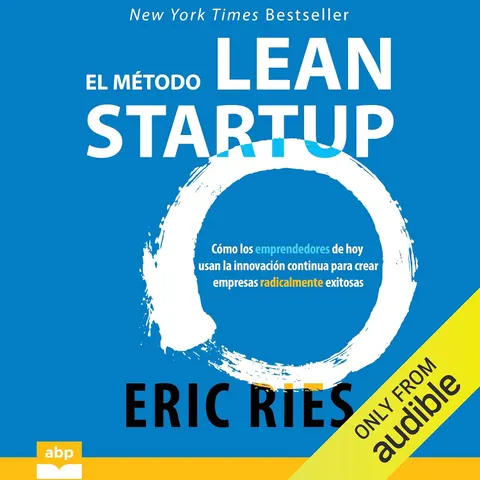
Cover of The Lean Startup
Bestseller
Corporate finance

The Lean Startup

★★★★☆ No ratings 1 min read

Eric Ries begins with a confession: his team spent months building a product that nobody wanted when it launched.

Affiliate CTA preview · enabled with monetization (phase 5).

Eric Ries introduces the methodology that transformed 21st-century company building: the Build-Measure-Learn cycle, the Minimum Viable Product, validation experiments, and the "pivot." Lean Startup adapts Toyota's lean manufacturing to startups and tech companies, reducing waste through rapid hypothesis validation.

Our review

Eric Ries begins with a confession: his team spent months building a product that nobody wanted when it launched. That failure is the origin of The Lean Startup, which transplants principles from lean manufacturing — most notably the Toyota Production System — into the process of building companies under conditions of radical uncertainty. The core argument is that the traditional business plan is a useful fiction in stable environments but an expensive trap in unpredictable ones. The alternative is the build-measure-learn feedback loop: release a minimum viable product (MVP) as quickly as possible, measure actual user behavior, and then decide whether to persevere with the current hypothesis or pivot to a different one. Ries coined or popularized a vocabulary — MVP, pivot, vanity metrics, innovation accounting — that has since become standard startup language. The book's main weakness is structural: the central ideas are strong but the text revisits them multiple times with different examples, making the second half feel repetitive for readers who absorbed the framework early. Its lasting contribution is the systematization of practices that previously existed only as tribal knowledge, giving founders a coherent and testable methodology for navigating early-stage uncertainty.

Who it's for

For early-stage founders and product managers; less relevant for established companies operating in mature, predictable markets.

Key takeaways

  • An MVP is not an unfinished product — it is the minimum experiment needed to test a specific business hypothesis.
  • Vanity metrics (page views, follower counts) obscure whether the business is actually progressing; actionable metrics show causality.
  • A pivot is not failure — it is a structured hypothesis change that preserves accumulated learning while adjusting direction.
  • Innovation accounting requires defining learning milestones before launch, not rationalizing results after the fact.
Fact

Published in 2011, the book was named one of the most influential business books of the decade by publications including Fast Company and The Economist.

Topics Eric RiesstartupMVPpivotemetodología ágil