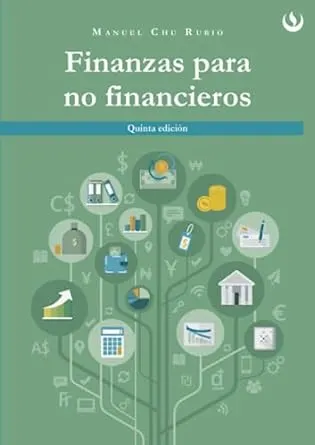
Cover of Finance for Non-Finance Professionals
Corporate finance

Finance for Non-Finance Professionals

★★★★☆ No ratings 1 min read

Manuel Oriol, an ESADE professor, achieves with this book what many corporate finance manuals do not: making accounting, financial statement analysis, and valuation concepts comprehensible and useful for someone without formal financial training.

Affiliate CTA preview · enabled with monetization (phase 5).

ESADE professor Manuel Oriol presents Spain's most widely used guide for non-financial managers, entrepreneurs, and professionals to understand financial statements, key profitability and solvency ratios, cash flow, investment analysis, and corporate financing. Rigorous but accessible, essential for business decision-makers without an accounting background.

Our review

Manuel Oriol, an ESADE professor, achieves with this book what many corporate finance manuals do not: making accounting, financial statement analysis, and valuation concepts comprehensible and useful for someone without formal financial training. Published in 2012, the book originates in the general management courses Oriol teaches at ESADE, which gives it a solid pedagogical structure and examples calibrated for managers and entrepreneurs who need to make financial decisions without being specialists. The book covers reading the balance sheet, income statement, and cash flow statement; the main profitability, liquidity, and leverage ratios; and the fundamentals of investment analysis. It is not a personal investment book nor a portfolio management book: its focus is business financial management. That makes it a reference for the manager or entrepreneur who wants to stop needing someone to translate financial reports for them. Its main limitation is age: published in 2012, some regulatory and accounting frameworks referenced have evolved, though the underlying financial logic is permanent.

Who it's for

For managers, entrepreneurs, and non-financial professionals who need to understand and interpret financial statements in their daily work; not aimed at the individual investor or finance student.

Key takeaways

  • A manager who cannot read a balance sheet cannot assess the real financial health of their company or make investment and debt decisions with their own criteria.
  • Operating cash flow is more revealing than accounting profit for evaluating the real sustainability of a business.
  • Financial ratios only have comparative meaning: they must be compared against the sector, the company's historical evolution, and its strategic objectives.
  • Investment analysis tools (NPV, IRR, payback) are decision tools, not certainty tools: their quality depends entirely on the quality of the underlying assumptions.
Fact

Manuel Oriol is a professor in the Finance department at ESADE Business School, which consistently ranks among the top five business schools in Europe according to Financial Times rankings.

Topics Manuel OriolESADEestados financierosratiosno financieros