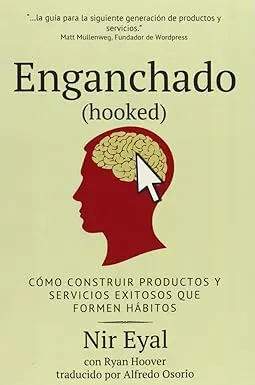
Cover of Hooked: How to Build Habit-Forming Products
Corporate finance

Hooked: How to Build Habit-Forming Products

Cómo Construir Productos y Servicios Exitosos Que Formen Hábitos

★★★★☆ No ratings 1 min read

In «Hooked», Nir Eyal exposes the skeleton behind almost every digital product we cannot stop using.

Affiliate CTA preview · enabled with monetization (phase 5).

Nir Eyal describes the "Hook Model" underlying the world's most addictive digital products: a four-phase cycle — trigger, action, variable reward, investment — that creates user habits. A product design guide for entrepreneurs and a dissection of the psychological mechanism behind compulsive platform use. Essential for tech investors evaluating habit moats.

Our review

In «Hooked», Nir Eyal exposes the skeleton behind almost every digital product we cannot stop using. The «Hook Model» he describes is a four-phase cycle: an external or internal trigger that initiates behaviour, a simple action with a high expected reward, a variable reward that activates the dopamine system precisely because it is unpredictable, and a user investment — data, content, followers — that makes the next cycle more likely. The book is simultaneously descriptive and prescriptive: it explains why Instagram, Slack, or mobile games hook us, and offers a framework for product designers to replicate those mechanics. Its strength lies in conceptual clarity and its ability to make visible the invisible architecture of digital habits. A critique that Eyal himself has acknowledged: the model can be used to build genuinely useful products or to manipulate vulnerable users, and the line between both uses is not always clear. A later book by the same author, «Indistractable», is partly a response to those ethical implications. Essential for understanding digital product design, though best read with critical awareness of its implications.

Who it's for

Essential for product designers, product managers, and tech entrepreneurs; also valuable for anyone who wants to understand the engagement mechanics of the products they use daily.

Key takeaways

  • The most addictive products do not exploit personality traits — they are built on deliberately designed habit loops.
  • Variable reward — not guaranteed reward — is the most powerful driver of repetitive behaviour according to behavioural research.
  • User investment (data, connections, content) creates switching costs that reinforce retention beyond mere satisfaction.
  • The same framework that creates useful products can design manipulative ones: the ethical context depends entirely on the designer's objectives.
Fact

«Hooked» was self-published in 2013 and subsequently released by Portfolio/Penguin in 2014; Eyal wrote it after studying the design patterns of companies like Twitter, Instagram, and Pinterest during his time as a Silicon Valley investor.

Topics Nir Eyalhábitos de productomodelo de ganchotecnologíaretención