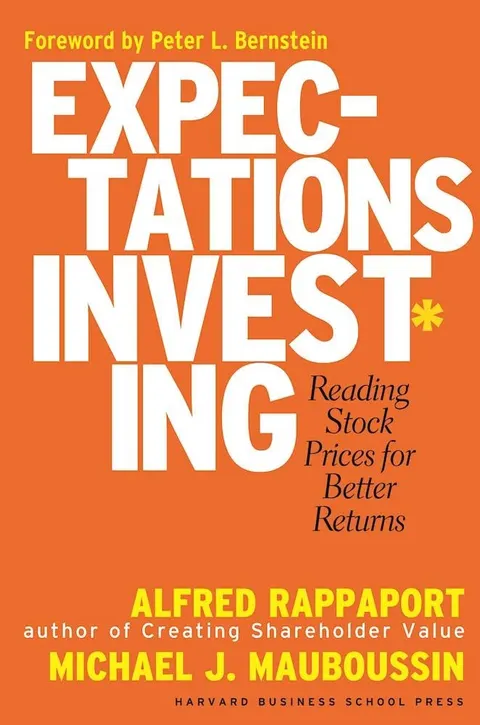
Cover of Expectations Investing: Reading Stock Prices for Better Returns
English only

Expectations Investing: Reading Stock Prices for Better Returns

Reading Stock Prices for Better Returns

★★★★☆ No ratings 1 min read

Expectations Investing begins from an uncomfortable but powerful premise: a stock's price already incorporates all market expectations, so consistent outperformance requires identifying when those expectations are wrong — not simply when a company is good.

Affiliate CTA preview · enabled with monetization (phase 5).

Mauboussin and Rappaport present a methodology to decipher what growth expectations are already embedded in a stock's price, and how to identify when the market is too optimistic or pessimistic. Instead of forecasting the future, investors learn to exploit moments when market expectations diverge from real fundamentals.

Our review

Expectations Investing begins from an uncomfortable but powerful premise: a stock's price already incorporates all market expectations, so consistent outperformance requires identifying when those expectations are wrong — not simply when a company is good. Mauboussin and Rappaport, two of the most rigorous voices in modern fundamental analysis, built the original 2001 framework around reverse DCF analysis — starting from the market price and working backward to infer what growth rate is already implied. The revised 2021 edition updates examples and adds reflections on low-rate environments and platform economics. The book is dense but intellectually honest: it does not promise a mechanical system for market-beating returns, but rather a more disciplined way of thinking about the relationship between price and value. Its greatest virtue is turning the question «is this company expensive?» into something quantifiable. The challenge is that it requires comfort with valuation models and concepts such as ROIC and cost of capital to apply the full framework.

Who it's for

Ideal for fundamental investors experienced in discounted cash flow valuation; not the right starting point for those new to company analysis.

Key takeaways

  • A stock's market price implicitly reflects specific growth expectations that can be inferred through reverse DCF analysis.
  • Beating the market requires identifying gaps between implied expectations and future reality, not just finding good businesses.
  • 'Expectation triggers' — catalysts that shift the market narrative — are the key to spotting investable opportunities.
  • Competitive position analysis is inseparable from valuation: without a durable advantage, growth tends to destroy value.
Fact

The original edition was published in 2001; the revised 2021 edition updated the framework to incorporate platform business economics and the low interest rate era.

Topics stock analysisexpectationsvaluationMauboussinfundamental analysis