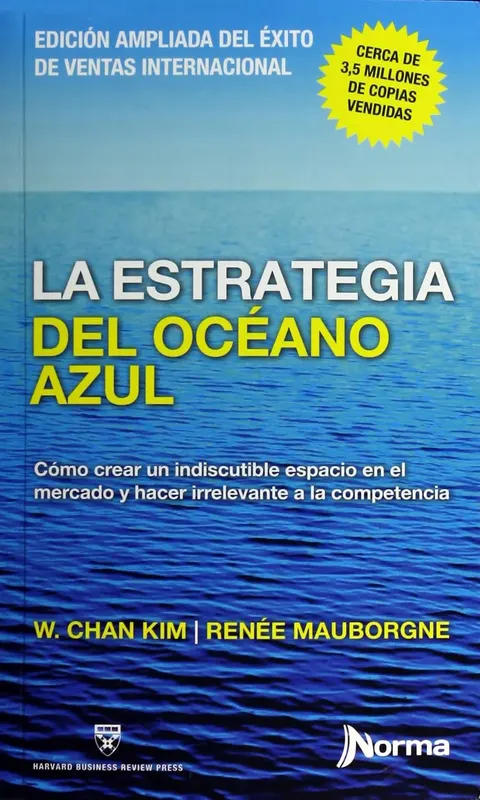
Cover of Blue Ocean Strategy
Bestseller
Corporate finance

Blue Ocean Strategy

The iconic articles by bestselling authors W. Chan Kim and Renée Mauborgne

★★★★☆ No ratings 1 min read

Kim and Mauborgne open with a challenge to conventional competitive thinking: fighting harder in overcrowded markets does not create new wealth, it redistributes existing wealth among rivals.

Affiliate CTA preview · enabled with monetization (phase 5).

Kim and Mauborgne distinguish between "red oceans" — saturated markets where all companies compete for the same customers — and "blue oceans" — uncontested market spaces created through value innovation. Using the Strategy Canvas and Value Curve tools, any company can identify radical differentiation and create new demand.

Our review

Kim and Mauborgne open with a challenge to conventional competitive thinking: fighting harder in overcrowded markets does not create new wealth, it redistributes existing wealth among rivals. Their alternative is the blue ocean — a market space with no competition, brought into existence by redefining the value variables of an industry rather than optimizing within its existing boundaries. The book is grounded in a study of 150 strategic moves across 30 industries over a century, and it delivers practical tools: the strategy canvas, the Four Actions Framework (eliminate, reduce, raise, create), and the buyer utility map. The case studies — Cirque du Soleil, Nintendo Wii, Casella Wines — are the book's greatest asset, because they make the logic concrete and replicable at the analytical level. The honest critique is that the framework excels at reverse-engineering successful blue ocean moves but offers less guidance on generating them from scratch in a genuinely novel context. Creativity is a prerequisite the methodology assumes but cannot supply. That limitation aside, this remains one of the most intellectually rigorous strategy books published in the past two decades, and its core questions — what to eliminate, reduce, raise, and create — are worth asking in any industry.

Who it's for

For executives, strategists, and founders rethinking their value proposition; less applicable for those looking for short-term operational tactics.

Key takeaways

  • Red ocean competition traps companies in a fight for market share that compresses margins without creating new demand.
  • Value innovation means simultaneously lowering cost and raising buyer value — not trading one off against the other.
  • The Four Actions Framework (Eliminate-Reduce-Raise-Create) is the core tool for designing a new market space.
  • A well-drawn strategy canvas makes visible exactly which variables your industry competes on and where divergence is possible.
Fact

First published in 2005, the book has been translated into more than 47 languages and is among the best-selling strategy books ever written.

Topics océano azulestrategiainnovación en valordiferenciaciónINSEAD