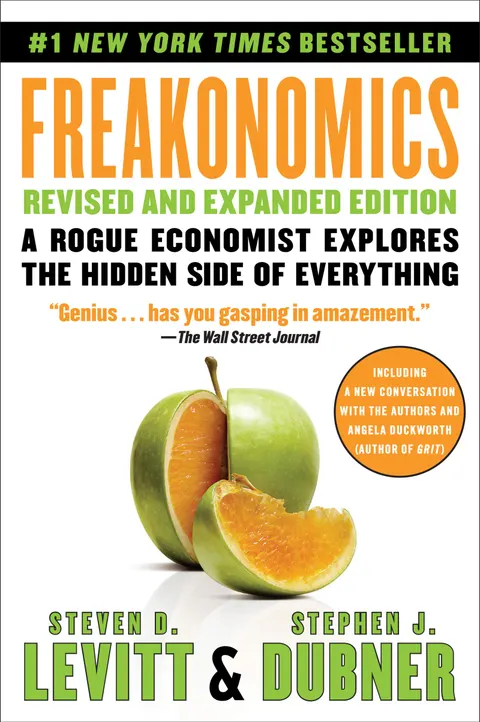
Freakonomics
A Rogue Economist Explores the Hidden Side of Everything
Levitt and Dubner achieved something rare in 2005: an economics book that reads like an ideas thriller.
Affiliate CTA preview · enabled with monetization (phase 5).
A Rogue Economist Explores the Hidden Side of Everything
Levitt and Dubner achieved something rare in 2005: an economics book that reads like an ideas thriller.
Affiliate CTA preview · enabled with monetization (phase 5).
Chicago economist Steven Levitt and journalist Stephen Dubner show how economics tools — incentives, information asymmetry, correlation vs causation — apply to any human problem, from drug dealer economics to teacher cheating schemes. Freakonomics popularized behavioral economics for mass audiences and proved that data reveals counter-intuitive truths.
Levitt and Dubner achieved something rare in 2005: an economics book that reads like an ideas thriller. The starting point is methodological — incentives shape human behavior in ways intuition does not anticipate, and data reveal truths that conventional morality prefers to ignore. The book applies economic analysis tools — group comparisons, control variables, correlation versus causation — to questions no one expected to find in a textbook: what do a primary school teacher and a sumo wrestler have in common? Why do drug dealers live with their mothers? The chapter on crime reduction in the United States, where Levitt links the legalization of abortion to a drop in crime two decades later, remains the most controversial and most cited. The book's honest limitation is that a collection of curious cases does not build a unified theory: it is more a demonstration of method than an explanatory framework for the world. Even so, as an introduction to causal thinking and the value of statistical skepticism, it is hard to beat in popular format.
Ideal for those approaching economic thinking for the first time and looking for an agile, provocative read; less useful for those with a background in applied economics.
FactPublished in 2005, Freakonomics sold more than four million copies in its first edition and spawned a franchise that includes a podcast with millions of monthly listeners.