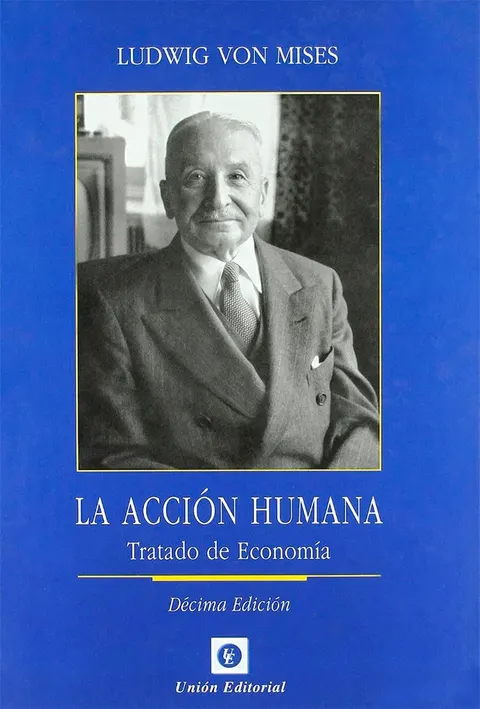
Cover of Human Action
Macroeconomics

Human Action

un ensayo sobre el método

★★★★½ No ratings 1 min read

«Human Action», published by Ludwig von Mises in 1949, is the most systematic and ambitious work of the Austrian School of economics and one of the most rigorous texts written in defense of the free market from philosophical foundations.

Affiliate CTA preview · enabled with monetization (phase 5).

Ludwig von Mises's magnum opus and the central text of the Austrian School. He develops praxeology — the science of purposeful human action — as the foundation of all economic theory, and argues that socialism is impossible without free prices. Highly technical, but profoundly influential on liberal economics.

Our review

«Human Action», published by Ludwig von Mises in 1949, is the most systematic and ambitious work of the Austrian School of economics and one of the most rigorous texts written in defense of the free market from philosophical foundations. Mises constructs the whole of economic theory from a single axiom: human action is always purposeful, goal-oriented, and aimed at reducing subjective uncertainty. From that starting point he deduces, through a priori logic, the foundations of money, credit, the business cycle, prices, and socialism. His critique of socialism and central planning — the famous «economic calculation problem» — is one of the most influential arguments in twentieth-century political economy: without market prices to transmit decentralized information, no planner can allocate resources efficiently. Reading «Human Action» is demanding: the text exceeds 900 pages, the style is dense, and the praxeological terminology requires adjustment. It is not a practical investment book or a personal finance guide; it is a theoretical edifice whose understanding provides a robust conceptual framework for why capital markets exist and what function they serve in economic coordination.

Who it's for

For readers with a serious interest in Austrian economic theory and the philosophy of the free market; not accessible without prior economics training and not an investment guide.

Key takeaways

  • Praxeology, as Mises defines it, studies purposeful human action independently of its specific content — from that base he deduces all of economics.
  • The economic calculation problem — the impossibility of allocating resources without market prices — is the most rigorous critique of centrally planned socialism.
  • The Austrian theory of the business cycle attributes unsustainable expansions and subsequent crises to artificial credit expansion beyond real savings.
  • Money, for Mises, is not a neutral veil over the real economy but a social institution that emerges spontaneously from exchange and that monetary intervention distorts.
Fact

«Human Action» was published in English in 1949 by Yale University Press; Mises had published a prior German-language version, «Nationalökonomie», in 1940 during his exile in Geneva.