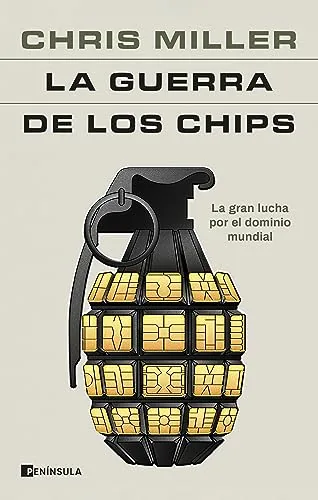
Cover of Chip War: The Fight for the World's Most Critical Technology
Bestseller
Business strategy

Chip War: The Fight for the World's Most Critical Technology

★★★★½ No ratings 1 min read

Chris Miller teaches international history at Tufts University's Fletcher School, and that academic origin explains the approach: the semiconductor is treated here not as a piece of technology but as the strategic asset ordering power between the United States, China and Taiwan.

Affiliate CTA preview · enabled with monetization (phase 5).

Miller, a historian of international relations, explains how the semiconductor went from an electronic component to the strategic asset determining the balance of power between the United States, China and Taiwan. The book reconstructs the real supply chain — ASML's monopoly in extreme ultraviolet lithography, the concentration of advanced fabrication at TSMC — and explains why that concentration is at once extraordinarily efficient and extraordinarily fragile. Financial Times Business Book of the Year 2022.

Our review

Chris Miller teaches international history at Tufts University's Fletcher School, and that academic origin explains the approach: the semiconductor is treated here not as a piece of technology but as the strategic asset ordering power between the United States, China and Taiwan. The book reconstructs the real supply chain, and that is its greatest value, because the chain is far narrower than almost anyone assumes. Extreme ultraviolet lithography, indispensable for the most advanced nodes, is made by a single company in the world, the Dutch firm ASML. Fabrication of the most advanced chips is concentrated in Taiwan, at TSMC, less than two hundred kilometres from the Chinese coast. Miller shows how that concentration is simultaneously the result of decades of efficient specialisation and a geopolitical fragility without historical precedent. The narrative is above all historical — the chapters on the Cold War and on the collapse of Japan's memory industry are excellent — and readers seeking concrete predictions about the Taiwan conflict will be unsatisfied, because Miller deliberately declines to make them.

Who it's for

For readers wanting to understand why semiconductors determine the geopolitical balance; less suited if you want investment analysis of the sector.

Key takeaways

  • Extreme ultraviolet lithography depends on a single global supplier: ASML.
  • The most advanced fabrication is concentrated in Taiwan, turning efficiency into fragility.
  • Miller is a historian: he explains how we got here, not how it ends.
  • The chapter on the collapse of Japan's memory industry is a textbook case.
Fact

Financial Times Business Book of the Year 2022; the Spanish edition is from Ediciones Península, translated by Àlex Guàrdia Berdiell.

Topics semiconductoresgeopolíticaTSMCASMLcadena de suministro