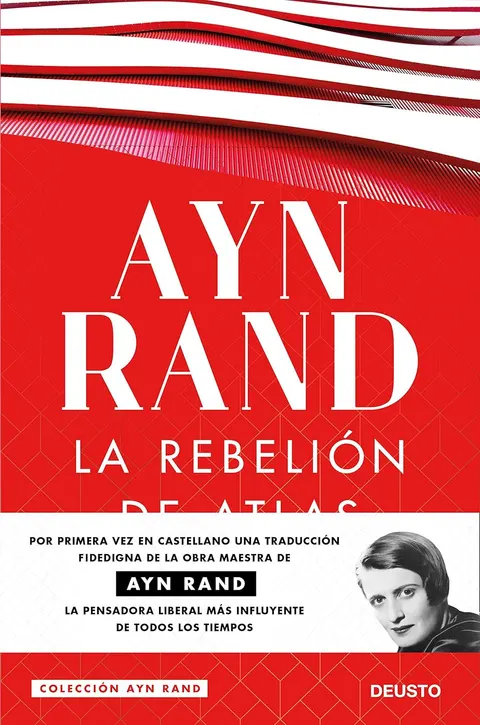
Cover of Atlas Shrugged
Macroeconomics

Atlas Shrugged

★★★★☆ No ratings 1 min read

«Atlas Shrugged», published in 1957, is the most ambitious philosophical novel of the twentieth century and one of the most revealing cultural documents of American libertarian thought.

Affiliate CTA preview · enabled with monetization (phase 5).

The most influential novel in understanding American libertarian thought. In a dystopian future, the intellectual and economic engines of civilization go on strike. Through this epic narrative, Rand exposes Objectivism: reason as the only guide, laissez-faire capitalism as the only moral system, and the productive individual as the engine of progress.

Our review

«Atlas Shrugged», published in 1957, is the most ambitious philosophical novel of the twentieth century and one of the most revealing cultural documents of American libertarian thought. Ayn Rand constructs a dystopian future in which the intellectual and entrepreneurial producers of civilization decide to stop working for a system that taxes, regulates, and despises them. The underlying philosophical argument — Objectivism — defends rational self-interest, reason as the only source of knowledge, and laissez-faire capitalism as the only political system compatible with human nature. As a novel, the work has genuine narrative virtues in its first third, but also significant limitations: the characters are moral archetypes rather than complex human beings, and the philosophical speeches — John Galt's monologue runs approximately 60 pages — interrupt the pace to the point of making the reading strenuous. As a philosophical text, Rand's Objectivism is systematic but dogmatic and has received little serious academic engagement. Its cultural influence, however, is undeniable: it has shaped generations of entrepreneurs, politicians, and Anglo-American libertarian thinkers. A book worth reading for its historical influence, with a critical eye.

Who it's for

For readers who want to understand Anglo-American libertarian thought and Objectivism in their original form; less suited for those seeking conventional literary fiction or academic philosophical rigor.

Key takeaways

  • Rand's Objectivism holds that reason — not faith, emotion, or tradition — is the only valid guide to human action.
  • The novel articulates a critique of altruism as a moral principle, arguing that rational self-interest is the consistent ethical foundation of capitalism.
  • The dichotomy between «producers» and «parasites» that Rand establishes has profoundly influenced libertarian political rhetoric throughout the twentieth century.
  • A 1991 Library of Congress and Book-of-the-Month Club survey ranked «Atlas Shrugged» as the second most influential book among American readers, after the Bible.
Fact

A joint 1991 Library of Congress and Book-of-the-Month Club survey ranked «Atlas Shrugged» as the second most influential book among American readers, after the Bible.