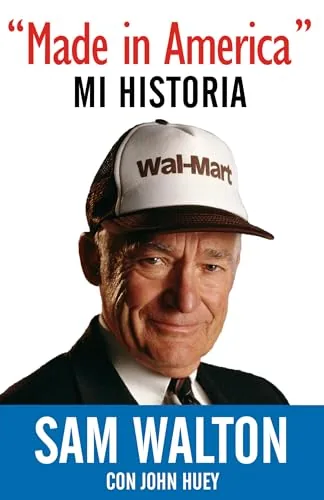
Cover of Made in America: My Story
Memoirs & biographies

Made in America: My Story

★★★★½ No ratings 1 min read

Sam Walton dictated these memoirs to journalist John Huey while dying of cancer, and that circumstance runs through the book: there is more urgency to explain the mechanism than to burnish the legend.

Affiliate CTA preview · enabled with monetization (phase 5).

The autobiography of Walmart's founder, written in the final months of his life with journalist John Huey. Walton traces the path from a variety store in Arkansas to the world's largest retailer, explaining the economics with unusual candour: thin margins sustained by obsessive cost control, a proprietary logistics network designed before software existed for it, and profit-sharing with employees. It is also a document of postwar American retail culture and the discipline of reinvesting every dollar back into the business.

Our review

Sam Walton dictated these memoirs to journalist John Huey while dying of cancer, and that circumstance runs through the book: there is more urgency to explain the mechanism than to burnish the legend. Walton describes going from a franchised variety store in Arkansas to the world's largest retailer by applying an arithmetic he repeats relentlessly: sell cheaper than anyone, accept a minimal unit margin, and make it up on turnover and volume. What is interesting is what it took to sustain that arithmetic. Walton built a proprietary distribution network — depots supplying stores less than a day's drive away — years before software existed to manage it, and financed expansion with a personal frugality that became part of the company's culture. The book is also candid about what Walton considers his mistakes: taking too long to share equity with store employees, and underestimating the social cost of displacing local retail. It reads like an operations manual disguised as an autobiography. Readers seeking introspection will find little; readers seeking to understand how a razor-thin-margin business can compound value for forty years will find plenty.

Who it's for

For readers wanting to understand low-margin retail economics from the inside; of little use if you want personal reflection or management theory.

Key takeaways

  • Low margins only compound if paired with high turnover and obsessive cost control.
  • Walton built his own logistics before technology made it obvious: the advantage was in infrastructure, not in the idea.
  • The culture of frugality was not an aesthetic: it was the condition that made the pricing model viable.
  • An autobiography dictated at the end of a life, with the bias of a man ordering his own story.
Fact

Published in 1992, the year of Walton's death, and written with journalist John Huey, later editor-in-chief of Time Inc.

Topics Sam WaltonWalmartretailautobiografíacostes