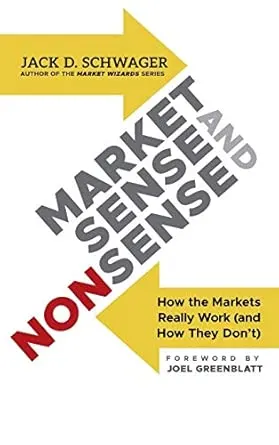
Cover of Market Sense and Nonsense: How the Markets Really Work (and How They Don't)
English only

Market Sense and Nonsense: How the Markets Really Work (and How They Don't)

How the Markets Really Work (and How They Don't)

★★★★☆ No ratings 1 min read

Jack Schwager, best known for interviewing elite traders in his «Market Wizards» series, shifts gears here and takes the role of critical analyst.

Affiliate CTA preview · enabled with monetization (phase 5).

Schwager dismantles the most widespread investor myths: from the belief that high-fee funds generate better returns to misunderstandings about diversification, risk, and asset correlation. With academic rigor and practical examples, he offers a more honest and effective thinking framework for building and managing investment portfolios.

Our review

Jack Schwager, best known for interviewing elite traders in his «Market Wizards» series, shifts gears here and takes the role of critical analyst. The central argument is as straightforward as it is unsettling: most of what investors accept as common knowledge — that high fees signal superior performance, that low correlation guarantees true diversification, that volatility equals risk — collapses under empirical scrutiny. Schwager writes not from academic distance but from decades of direct market observation, which allows him to expose contradictions with concrete examples and unambiguous language. The book is organized around specific myths, making non-linear reading practical: each chapter stands largely on its own. Its strongest contributions include the analysis of active management versus index funds, the distinction between real risk and perceived volatility, and a rigorous look at what genuine diversification actually requires. The weakest sections are those where arguments drawn from futures markets and hedge funds — Schwager's natural habitat — are generalized to retail investors with more confidence than the evidence strictly warrants. This is not a strategy manual but a conceptual detox, valuable precisely because it challenges the most entrenched assumptions rather than offering comfortable reassurance.

Who it's for

For investors with foundational market knowledge who want to stress-test their assumptions about funds, risk, and diversification; less useful for complete beginners or those seeking actionable trading strategies.

Key takeaways

  • High fund fees do not predict better returns; the historical record points consistently and sharply in the opposite direction.
  • Volatility and risk are not synonymous: a highly volatile asset bought at the right price can carry less real risk than a seemingly stable one bought at the wrong one.
  • True diversification depends on genuine low correlation between asset classes, not simply holding many different securities within the same category.
  • Many popular financial intuitions persist not because they are correct, but because they are difficult to disprove without long-horizon data most investors never examine.
Fact

Published in 2013 by Wiley, the same publisher behind the «Market Wizards» series, which Schwager launched in 1989.

Topics investing mythsportfolio managementJack Schwagerdiversificationrisk