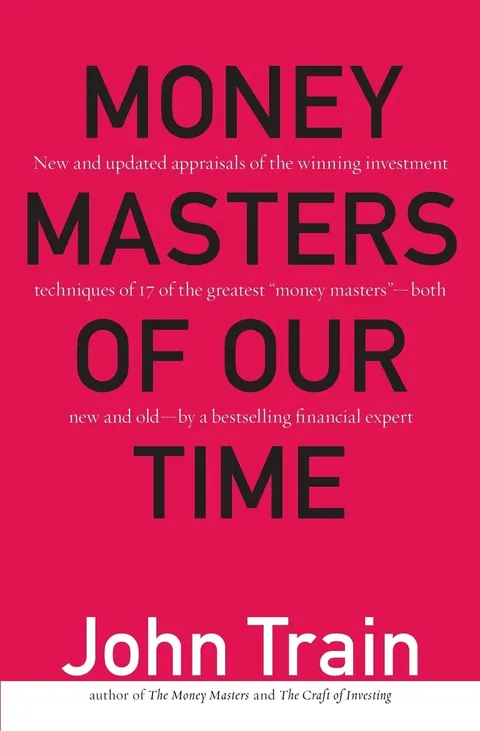
Cover of Money Masters of Our Time
English only

Money Masters of Our Time

★★★★☆ No ratings 1 min read

Money Masters of Our Time is the update John Train produced in 2000 of his earlier work The Money Masters (1980), expanding the roster of investors analyzed and incorporating figures who had emerged in the preceding two decades.

Affiliate CTA preview · enabled with monetization (phase 5).

Train interviews and analyzes thirteen of the most successful investors of the 20th century: Buffett, Soros, Templeton, Lynch, and others. For each, he explains their investment philosophy, stock selection process, risk management, and defining character traits — a unique manual for learning directly from the greatest minds in asset management.

Our review

Money Masters of Our Time is the update John Train produced in 2000 of his earlier work The Money Masters (1980), expanding the roster of investors analyzed and incorporating figures who had emerged in the preceding two decades. Train interviewed and profiled thirteen of the most successful investors of the twentieth century — including Buffett, Soros, Templeton, Lynch, Neff, and Robertson — and for each reconstructs their philosophy, stock selection process, risk management approach, and the character traits he considers decisive. The book's greatest virtue is its comparative synthesis: by presenting such distinct profiles, Train demonstrates that no single method exists for consistently beating the market, and that discipline, internal consistency, and self-knowledge are the common denominators. The limitation is inherent to the biographical genre: investors tend to rationalize their successes retrospectively with more elegance than they experienced in the moment, and Train does not always address this gap. The 2000 edition inevitably carries the flavor of its era — the peak of the technology cycle — though the value investor profiles remain more timeless.

Who it's for

For investors who want to study the diversity of philosophies and processes among the great investors of the twentieth century; excellent as a first read before going deeper into the individual autobiographies or books of each figure.

Key takeaways

  • No single method exists for consistently beating the market: Buffett, Soros, Lynch, and Templeton succeeded with radically different philosophies.
  • Discipline, internal consistency, and self-knowledge are the common denominators across all the great investors analyzed, transcending any specific technique.
  • The circle of competence — investing only in what one deeply understands — emerges as a recurring principle, though defined differently by each investor.
  • Psychology and character are as decisive as analytical intelligence in long-term investment results.
Fact

Money Masters of Our Time was published in 2000 as an update to The Money Masters (1980). John Train was a wealth manager and founder of Train, Smith Counsel, and a regular contributor to The Wall Street Journal.

Topics investment legendsWarren BuffettGeorge SorosPeter Lynchvalue investing