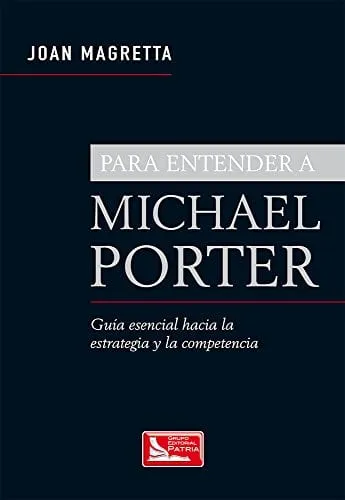
Cover of Understanding Michael Porter
Business strategy

Understanding Michael Porter

★★★★☆ No ratings 1 min read

Michael Porter's work has a known problem: it is as fundamental as it is hard to read.

Affiliate CTA preview · enabled with monetization (phase 5).

Joan Magretta, Porter's longtime collaborator at Harvard Business Review, wrote the definitive guide to absorbing his work without a thousand academic pages: what competitive advantage really is, why competing to be «the best» is a trap, how to read the five forces, and what activity fit means.

Our review

Michael Porter's work has a known problem: it is as fundamental as it is hard to read. Joan Magretta — HBR's strategy editor for years and a direct collaborator of Porter — wrote the solution: a two-hundred-page synthesis capturing the essentials of «Competitive Strategy» and «Competitive Advantage» with a clarity the originals never had. The book shines especially in correcting the misunderstandings Porter's popularization has generated: competition is not about «being the best» — a destructive race toward convergence — but about being unique; strategy is not aspiration but the choice of a defensible position; and competitive advantage is not a marketing phrase but something that must show up in the income statement, in premium prices or lower costs. Magretta adds a closing interview with Porter that condenses decades of thought into direct answers. For readers with limited time, this book delivers 80% of Porter's value in 20% of the pages; for investors, it is the fast lane to serious moat analysis.

Who it's for

For anyone wanting to absorb Porter's thinking without crossing the academic originals; ideal as a first competitive strategy read.

Key takeaways

  • Competing to be «the best» leads to convergence and destroys profitability; competing to be unique creates it.
  • Competitive advantage must be visible in the numbers: premium prices, lower costs, or both — otherwise it is rhetoric.
  • The essence of strategy is choosing what not to do: without trade-offs there is no defensible position.
  • Fit between activities — each piece reinforcing the others — is the most underrated barrier to imitation.
Fact

Magretta worked with Porter at Harvard Business Review, where she was strategy editor and a McKinsey Award winner; the book (2011) closes with an extensive interview with Porter himself.