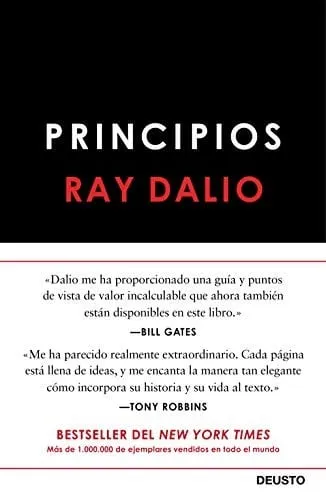
Cover of Principles: Life and Work
Bestseller
Business strategy

Principles: Life and Work

★★★★½ No ratings 1 min read

Ray Dalio founded Bridgewater in his apartment in 1975 and turned it into the world's largest hedge fund; this book explains the operating system he did it with.

Affiliate CTA preview · enabled with monetization (phase 5).

Ray Dalio built Bridgewater, the world's largest hedge fund, on a radical idea: turning every decision, mistake, and lesson into explicit, written, debatable principles. This book collects them — life principles first, then work principles — along with the personal story of how he arrived at them, including the 1982 blowup that nearly ended his career.

Our review

Ray Dalio founded Bridgewater in his apartment in 1975 and turned it into the world's largest hedge fund; this book explains the operating system he did it with. The first part is autobiographical and pivots on the founding error: in 1982 Dalio publicly predicted a depression that never came, lost nearly everything, and had to borrow money from his father. From that humiliation he extracted the principle that organizes everything else: «how do I know I'm right?». The answer was principles — explicit, written rules for every type of decision — and a culture of «radical truth and radical transparency» where ideas are weighed by merit adjusted for the credibility of whoever proposes them, not by hierarchy. The second part catalogues those life and work principles in a reference format rather than a linear read. The system has critics — Bridgewater's culture has also been described as suffocating — and the book itself occasionally sins with solemnity. But as a manual for decision-making under uncertainty written by someone who bet billions applying it, it has no equal.

Who it's for

For executives, investors, and anyone interested in explicit decision systems; works better as a reference than as a straight-through read.

Key takeaways

  • Pain + reflection = progress: mistakes are data, and recording them as principles avoids paying for them twice.
  • The «idea meritocracy» weighs opinions by each person's demonstrated credibility in that domain, not by their title.
  • Actively seeking thoughtful disagreement — credible people who think the opposite — is the best protection against one's own ego.
  • Systematizing recurring decisions (as written, reviewable algorithms) frees attention for genuinely new ones.
Fact

Dalio published a free PDF version of his principles that was downloaded over three million times before the 2017 book; the Spanish edition was published by Deusto in 2018.