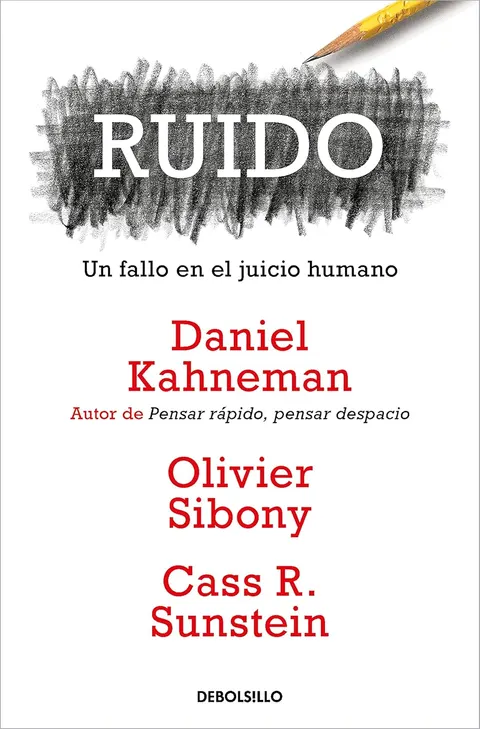
Cover of Noise: A Flaw in Human Judgment
New
Psychology & decisions

Noise: A Flaw in Human Judgment

★★★★☆ No ratings 1 min read

Kahneman, already a Nobel laureate in Economics, returns to the study of human judgment failures alongside Sibony and Sunstein to explore a phenomenon distinct from bias: noise.

Affiliate CTA preview · enabled with monetization (phase 5).

Kahneman's last major work tackles a problem distinct from cognitive biases: noise, the unwanted random variability in human judgments. Two doctors examining the same case reach different diagnoses; two analysts valuing the same company reach different prices. This noise is as damaging as bias but far less studied. Kahneman proposes "noise audits" and decision systems to reduce it.

Our review

Kahneman, already a Nobel laureate in Economics, returns to the study of human judgment failures alongside Sibony and Sunstein to explore a phenomenon distinct from bias: noise. Where bias is systematic and predictable (always in the same direction), noise is the random, unwanted variability in the judgments of people who should reach the same conclusions. The book's most striking experiment is blunt: when several doctors, judges, or appraisers evaluate the same case independently, the dispersion of their verdicts is far greater than anyone would expect. That noise has direct consequences for decisions in health, justice, and hiring. The conceptual contribution is solid, but the book has the usual flaw of extended popular essays: the central argument is established in the first chapters and the rest of the work adds layers of cases without substantially transforming the thesis. The "noise audits" proposed as a solution are interesting but underdeveloped. For those who have already read Kahneman's "Thinking, Fast and Slow," this book offers a valuable complement; for those who have not, it is a perfectly valid entry point.

Who it's for

For professionals who make decisions with significant consequences (doctors, judges, recruiters, investors) and want to understand how to reduce unwanted variability in their judgments.

Key takeaways

  • Noise (random variability) in human judgment causes as much harm as systematic biases but receives far less attention.
  • Organizations consistently underestimate how much the judgments of different people vary when facing the same case.
  • Simple rules and algorithms reduce noise more effectively than individual experience or intuition.
  • Separating the evaluation process from the final decision improves the quality of collective judgment.
Fact

Published in 2021, the book describes an experiment in which 208 employees of an insurance company independently assessed the same case: the average variation between appraisers exceeded 50%.

Topics Kahnemanruidovariabilidadjuicio humanodecisiones