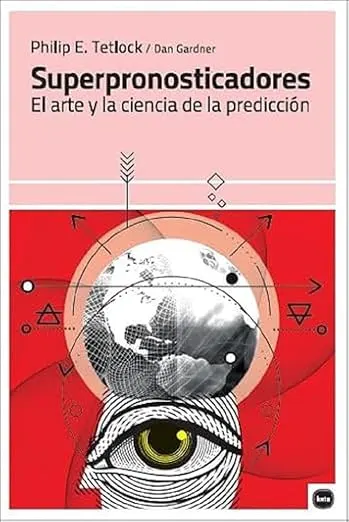
Cover of Superforecasting
Psychology & decisions

Superforecasting

The Art and Science of Prediction

★★★★☆ No ratings 1 min read

Philip Tetlock spent twenty years on a systematic study that became a methodological landmark: the Expert Political Judgment project, in which thousands of experts — economists, analysts, political scientists — made predictions about future events that were subsequently checked against reality.

Affiliate CTA preview · enabled with monetization (phase 5).

After 20 years studying thousands of expert predictions, Tetlock finds most predict worse than chance. But a small group of "superforecasters" consistently outperform: not domain experts, but people with a distinctive thinking style — open to updating beliefs, obsessed with probability calibration, and able to distinguish known from unknown.

Our review

Philip Tetlock spent twenty years on a systematic study that became a methodological landmark: the Expert Political Judgment project, in which thousands of experts — economists, analysts, political scientists — made predictions about future events that were subsequently checked against reality. The verdict was damning: most experts predicted worse than simple extrapolation models. But the most valuable finding was not expert failure, but the existence of a small subgroup — the «superforecasters» — who consistently outperformed everyone else. «Superforecasting», written with Dan Gardner, analyses what characterises this group: they are not smarter or better informed, but they think differently. They update their beliefs frequently, quantify uncertainty rather than avoiding it, and work in teams with epistemic humility. The book is rigorous and narrated with agility, though the second half extends somewhat unnecessarily into illustrative examples. Its direct application to portfolio management is limited — Tetlock studies geopolitical, not market, predictions — but the thinking method it describes transfers clearly to any domain involving decisions under uncertainty.

Who it's for

For analysts, fund managers, and professionals who make forecast-based decisions and want to improve the calibration of their judgments.

Key takeaways

  • Most self-proclaimed experts predict worse than simple statistical methods; an analyst's public confidence does not correlate with their predictive accuracy.
  • Superforecasters are distinguished by updating their probabilities frequently and in small increments, not by making large conceptual bets.
  • Quantifying uncertainty — saying «there's a 70% probability» rather than «probably» — forces more precise thinking and makes it easier to learn from errors.
  • Teamwork with diverse perspectives systematically improves individual forecasts, provided the group avoids groupthink.
Fact

Tetlock's Expert Political Judgment project, which underpins the book, began in 1984 and accumulated over 80,000 predictions from 284 experts over two decades.

Topics Philip Tetlockprediccionescalibraciónincertidumbreprobabilidades