Good Strategy / Bad Strategy
Richard Rumelt opens with a provocation anyone who has set foot in a company will recognize: most documents called «strategy» contain none.
Affiliate CTA preview · enabled with monetization (phase 5).
Richard Rumelt opens with a provocation anyone who has set foot in a company will recognize: most documents called «strategy» contain none.
Affiliate CTA preview · enabled with monetization (phase 5).
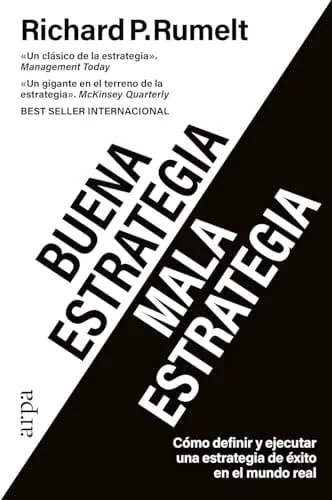
UCLA professor Richard Rumelt wrote the antidote to corporate fluff: most of what is called «strategy» — visions, stretch goals, wish lists — is not strategy. Good strategy has a three-part kernel: an accurate diagnosis, a guiding policy, and coherent actions. From Hannibal to Apple, arguably the best business strategy book ever written.
Richard Rumelt opens with a provocation anyone who has set foot in a company will recognize: most documents called «strategy» contain none. Inspiring visions, ambitious goals, lists of initiatives — what Rumelt baptizes «bad strategy» — are substitutes for the only hard thing: choosing. Good strategy, he argues, has a three-part kernel: a diagnosis identifying the essential challenge (what is really going on), a guiding policy deciding the approach to overcome it, and a set of coherent actions executing it in coordination. The rest of the book deploys the sources of strategic power — leverage, advantage, industry dynamics, design — with the best case collection in the genre: from Trafalgar to the iPhone, from Walmart versus Kmart to the decline of the American TV industry. Rumelt writes with cutting clarity and explicit contempt for motivational verbiage, which makes the reading extraordinarily refreshing. If you could read only one business strategy book, most serious specialists would choose this one.
For executives, entrepreneurs, and analysts who want to distinguish real strategy from corporate theatre; also useful for investors evaluating the strategy of companies they analyse.
FactRumelt is professor emeritus at UCLA Anderson and was described by The Economist as one of the twenty-five most influential living management thinkers; the Spanish edition was published by Arpa in 2024.