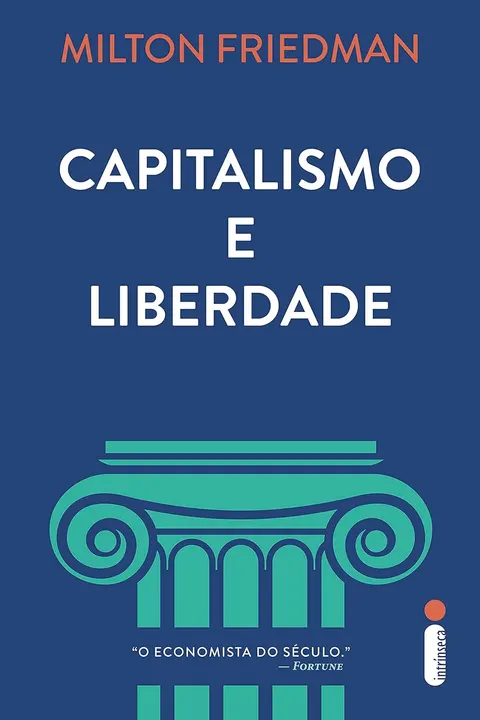
Cover of Capitalism and Freedom
Macroeconomics

Capitalism and Freedom

★★★★☆ No ratings 1 min read

«Capitalism and Freedom», published in 1962, is Milton Friedman's most accessible book and the founding document of monetarism as a political-economic program.

Affiliate CTA preview · enabled with monetization (phase 5).

Nobel laureate Milton Friedman's most accessible book, outlining his vision of limited government in a free society. He defends free markets, stable money, the negative income tax, and school vouchers. Published in 1962, many proposals were adopted worldwide decades later. The essential counterpoint to Keynes and Piketty.

Our review

«Capitalism and Freedom», published in 1962, is Milton Friedman's most accessible book and the founding document of monetarism as a political-economic program. Friedman, who would receive the Nobel Prize in Economics in 1976, sets out his central thesis: economic freedom and political freedom are inseparable, and any significant expansion of the state's role in the economy inevitably threatens both. The book covers a broad spectrum of policies — education, the professional military, occupational licensing, monetary policy, exchange rates, income distribution — and in each case Friedman argues against state intervention and in favor of market mechanisms. His proposal for a negative income tax as an alternative to welfare systems is one of the book's most original and debated contributions. The most evident limitation is that Friedman writes from an openly declared ideological position and his arguments, while analytically coherent, select evidence consistently with his prior conclusions. The book is over 60 years old and some proposals have aged better than others. As an exposition of the monetarist program and the Chicago School, however, it remains the clearest reference available.

Who it's for

For readers interested in political economy and the debate over the state's role in the economy; essential for understanding monetarism and the Chicago School in their original formulation.

Key takeaways

  • Economic freedom — the ability to participate in voluntary transactions — is a necessary, though not sufficient, condition of political freedom.
  • Monetary policy should follow predictable rules rather than central bank discretion, to avoid boom-and-bust cycles.
  • The negative income tax — a direct transfer to those below the tax threshold — is more efficient and less distorting than complex welfare systems.
  • Mandatory occupational licensing benefits established practitioners at the expense of consumers and new market entrants.
Fact

Milton Friedman received the Nobel Prize in Economics in 1976; «Capitalism and Freedom», published in 1962, sold over 400,000 copies before the publisher actively promoted it, driven entirely by word of mouth.

Topics Milton Friedmanmonetarismolibre mercadoNobelliberalismo económico