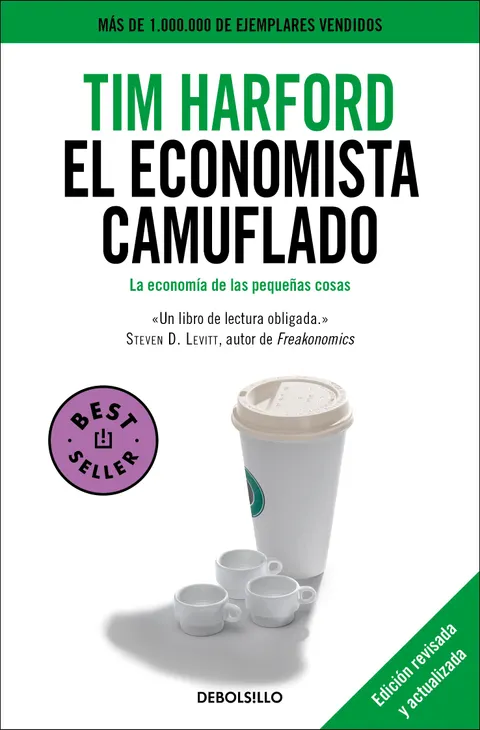
Cover of The Undercover Economist
Macroeconomics

The Undercover Economist

La economía de las pequeñas cosas

★★★★☆ 10.0/10 (1) 1 min read

«The Undercover Economist», published in 2005, turned Tim Harford into the most widely read economics columnist at the Financial Times.

Affiliate CTA preview · enabled with monetization (phase 5).

Tim Harford uses information economics and incentives to explain everyday mysteries: why airport coffee is so expensive, how real estate markets work, why supermarket pricing is counter-intuitive, and what really explains the wealth gap between countries. One of the best introductions to modern economic thinking for non-specialists.

Our review

«The Undercover Economist», published in 2005, turned Tim Harford into the most widely read economics columnist at the Financial Times. His ambition is clear from the opening pages: to show that economics is not an abstract discipline of mathematical models but a way of seeing the world that reveals the hidden forces behind everyday decisions. Harford uses the price of airport coffee as a gateway to market power theory; the inefficiency of the British healthcare system to illustrate public goods failures; and the used car market to explain Akerlof's information asymmetry. The tone is conversational, slightly ironic, and accessible without being condescending. His principal virtue is pedagogical: he makes readers wonder why things cost what they cost and understand the logic of incentives behind seemingly arbitrary phenomena. The most obvious limitation is deliberate simplification; the models Harford presents are useful but strip out the institutional complexity that any academic economist would consider essential. Readers with a university-level economics background may find it thin. For everyone else, it is one of the most effective introductions to applied economic thinking available in popular non-fiction.

Who it's for

For readers without an economics background who want to understand the incentives and price logic shaping their daily lives; less valuable for those with formal economics training.

Key takeaways

  • High prices in captive environments (airports, stadiums) reflect market power and differential willingness to pay, not arbitrary greed.
  • Information asymmetry — one party knowing more than the other — explains many market failures that appear irrational on the surface.
  • Free-at-point-of-use health systems generate excess demand because users don't internalize the real cost of the service.
  • Understanding the incentives of actors is more useful than labeling their behavior as rational or irrational.
Fact

Tim Harford has written the "Dear Economist" column in the Financial Times since 2003; «The Undercover Economist» (2005) was his first popular economics book.

Topics Tim Harfordeconomía cotidianaincentivosinformacióndivulgación