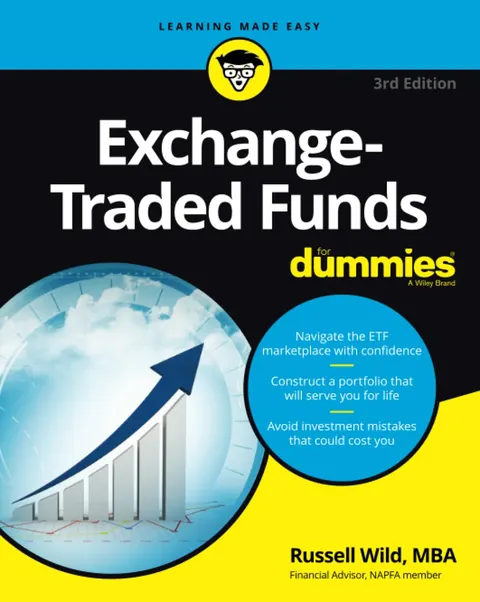
Cover of Exchange-Traded Funds for Dummies
Index funds / FIRE

Exchange-Traded Funds for Dummies

★★★★☆ No ratings 1 min read

Russell Wild's «Exchange-Traded Funds for Dummies» belongs to the reference series that made the «Dummies» format synonymous with accessible introductions to complex topics.

Affiliate CTA preview · enabled with monetization (phase 5).

The reference guide on exchange-traded funds from the Dummies series. Russell Wild explains what ETFs are, how they work, their advantages over traditional mutual funds, and how to build a diversified portfolio using them as building blocks — covering equity, fixed income, commodity, currency, and real estate ETFs.

Our review

Russell Wild's «Exchange-Traded Funds for Dummies» belongs to the reference series that made the «Dummies» format synonymous with accessible introductions to complex topics. Wild, an independent financial advisor, offers a systematic explanation of what ETFs are, how they trade on exchanges unlike traditional mutual funds, their advantages in terms of cost and tax efficiency, and how to build diversified portfolios using them as primary building blocks. The book also covers fixed-income ETFs, commodity ETFs, and sector-specific vehicles, providing a broader panorama than readers might expect. The original 2006 edition has been updated in subsequent printings, which improves its relevance in a rapidly evolved ETF market. The most obvious limitation is its Anglo-Saxon frame: the book is oriented toward the US market in terms of platforms, tax treatment, and specific products. Non-US readers will need to translate the categories and filter which ETFs are available on their broker and compliant with their local tax rules. Even with that caveat, it remains one of the clearest and most complete texts in Spanish on this asset class.

Who it's for

For beginner to intermediate investors who want to understand ETFs from first principles before integrating them into a portfolio; Spanish readers should supplement it with local information on tax treatment and product availability.

Key takeaways

  • An ETF replicates the behavior of an index or asset basket and trades on exchanges like a stock, combining fund-style diversification with intraday liquidity.
  • The total expense ratio (TER) is the primary cost factor to consider; seemingly small differences compound significantly over the long term.
  • Accumulation ETFs, which automatically reinvest dividends, can be more tax-efficient than distribution ETFs in many European jurisdictions.
  • ETF diversification allows building a global portfolio with relatively few positions and minimal costs.
Fact

Russell Wild holds the CFP (Certified Financial Planner) designation and runs his own independent financial advisory firm in Allentown, Pennsylvania.

Topics ETFRussell Wildfondos cotizadosinversión pasivacartera diversificada