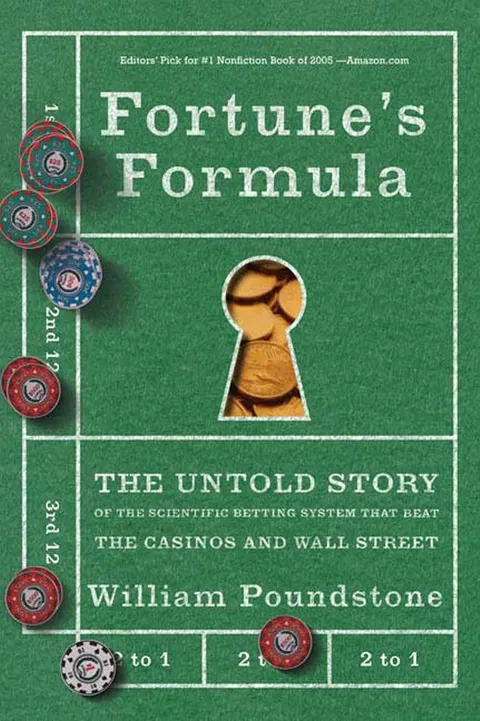
Cover of Fortune's Formula: The Untold Story of the Scientific Betting System That Beat the Casinos and Wall Street
English only

Fortune's Formula: The Untold Story of the Scientific Betting System That Beat the Casinos and Wall Street

The Untold Story of the Scientific Betting System That Beat the Casinos and Wall Street

★★★★½ 7.0/10 (4) 1 min read

Fortune's Formula tells the story of the Kelly Criterion — an equation that determines the optimal size of each bet to maximize long-term capital growth — as if it were a nonfiction thriller.

Affiliate CTA preview · enabled with monetization (phase 5).

The fascinating story of the Kelly Criterion — the mathematical formula developed at Bell Labs that calculates the optimal bet size to maximize long-term capital growth. Poundstone narrates how it was adopted by professional gamblers, hedge fund managers like Ed Thorp, and organized crime, revealing what it teaches about risk, greed, and capital management.

Our review

Fortune's Formula tells the story of the Kelly Criterion — an equation that determines the optimal size of each bet to maximize long-term capital growth — as if it were a nonfiction thriller. William Poundstone weaves the narrative around John Kelly, the Bell Labs physicist who published the formula in 1956, and connects it to figures as varied as Claude Shannon, Edward Thorp, and American organized crime figures who attempted to exploit the system in sports betting. The book's great merit is making a sophisticated mathematical concept accessible without sacrificing rigor, and the historical account of how the formula traveled from telecommunications laboratories to Wall Street is genuinely compelling. Readers should note, however, that full Kelly is extremely volatile in practice — most quantitative managers use fractional Kelly (half-Kelly, quarter-Kelly) — and the book does not always clarify this distinction with sufficient precision. An essential work for understanding risk management and portfolio sizing from a statistical perspective.

Who it's for

Recommended for any investor or reader interested in risk management, information theory, and the intellectual history of quantitative finance.

Key takeaways

  • The Kelly Criterion calculates the capital fraction that maximizes long-term geometric growth by balancing return against the risk of ruin.
  • Betting more than full Kelly accelerates short-term growth but exponentially increases the risk of catastrophic loss.
  • The formula has direct portfolio management applications, though in practice most managers use reduced versions (half-Kelly or quarter-Kelly) to control volatility.
  • The history of the Kelly Criterion illustrates how ideas born in information theory can have profound practical consequences in uncertain environments.
Fact

John L. Kelly Jr. published the formula in 1956 in the Bell System Technical Journal, originally in the context of information transmission, not financial investing.

Topics Kelly criterionprobabilityquantitative financerisk managementbetting