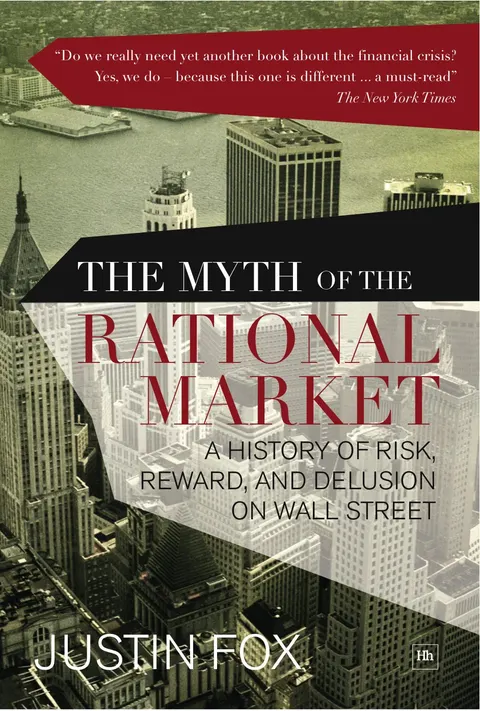
Cover of The Myth of the Rational Market: A History of Risk, Reward, and Delusion on Wall Street
English only

The Myth of the Rational Market: A History of Risk, Reward, and Delusion on Wall Street

A History of Risk, Reward, and Delusion on Wall Street

★★★★☆ No ratings 1 min read

The Myth of the Rational Market is the most comprehensive intellectual history available of the birth, peak, and questioning of the efficient markets hypothesis (EMH), told as if narrating a scientific revolution.

Affiliate CTA preview · enabled with monetization (phase 5).

An intellectual history of the birth, peak, and decline of the efficient markets hypothesis. Fox traces economic thought from early asset pricing models to the rise of behavioral economics, explaining why economists and markets failed so spectacularly before the 2008 crisis and what lessons can be drawn.

Our review

The Myth of the Rational Market is the most comprehensive intellectual history available of the birth, peak, and questioning of the efficient markets hypothesis (EMH), told as if narrating a scientific revolution. Justin Fox, then editor at Time, reconstructs the decades in which economists such as Eugene Fama, Fischer Black, and William Sharpe built the pillars of modern financial thought — CAPM, Black-Scholes, efficient markets — and how their assumptions were gradually eroded by empirical data and the rise of behavioral finance. The book is especially valuable because it shows that the history of economic thought is not linear: ideas triumph not always because they are correct but because they are useful at a particular moment. Published in 2009, immediately after the financial crisis, it carries an implicit charge of «where did the models fail?» that makes it especially relevant. The limitation is that Fox is a journalist, not an economist: the book excels at narrative and historical context but does not engage deeply with the underlying mathematical models. An ideal companion to Andrew Lo's Adaptive Markets.

Who it's for

For any reader interested in the history of modern economic and financial thought; does not require advanced mathematical training but benefits from some familiarity with basic portfolio theory concepts.

Key takeaways

  • The efficient markets hypothesis did not emerge as revealed truth but as a gradual construction by multiple researchers over decades.
  • Empirical anomalies — the January effect, excess volatility, momentum returns — accumulated for years before the dominant paradigm took them seriously.
  • Economic ideas do not triumph solely because they are correct: institutional context, practical utility, and industry incentives also determine which theories get adopted.
  • The 2008 crisis was not the "death" of the EMH but an acceleration of the debate about its limits — a debate that remains open in academia.
Fact

The Myth of the Rational Market was published in 2009 by Justin Fox, who was then an editor at Time magazine. The book received the Financial Times and Goldman Sachs Business Book of the Year Award for 2009.

Topics efficient marketsbehavioral economicsfinancial historyacademic financetheory