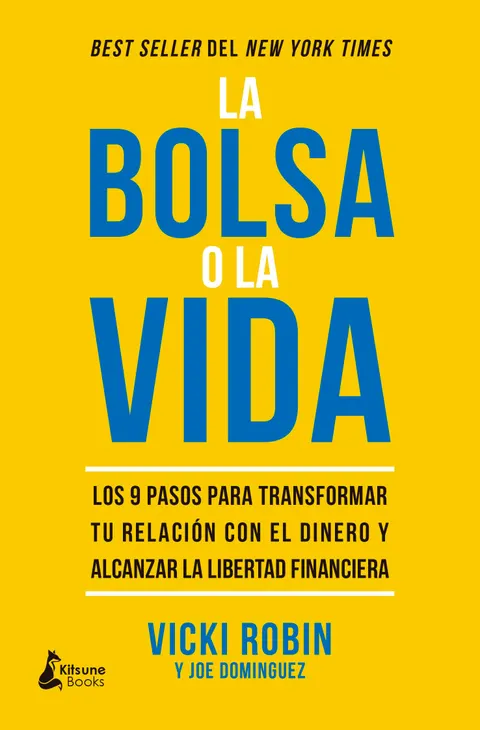
Cover of Your Money or Your Life
Index funds / FIRE

Your Money or Your Life

9 Steps to Transforming Your Relationship with Money and Achieving Financial Independence: Fully Revised and Updated for 2018

★★★★½ No ratings 1 min read

Your Money or Your Life is the foundational text of the FIRE movement and one of the most influential personal finance books of the twentieth century.

Affiliate CTA preview · enabled with monetization (phase 5).

The foundational FIRE movement text. Robin and Dominguez propose a nine-step program to transform your relationship with money, introducing the concept that money is "life energy" and the crossover point where passive income exceeds expenses.

Our review

Your Money or Your Life is the foundational text of the FIRE movement and one of the most influential personal finance books of the twentieth century. Vicki Robin and Joe Dominguez propose a radical reframing of the relationship between work and money: the central premise is that money is not an end in itself but life energy converted into numbers, and that every expense should be evaluated in terms of the hours of life it took to earn it. The nine-step programme they outline is surprisingly practical for a book with such philosophical weight: it includes calculating one's «real hourly rate» — what one actually earns per hour once all work-related costs are deducted — exhaustive expense tracking, and a gradual build towards financial independence. What distinguishes this book from most savings manuals is that it does not speak of deprivation but of awareness: the goal is not to spend less for its own sake, but to spend in alignment with what one genuinely values. Published in 1992, some sections on investment have aged — particularly those treating Treasury bonds as the sole accumulation vehicle — but the philosophical core remains extraordinarily relevant.

Who it's for

For any reader interested in rethinking their relationship with work and consumption, especially those feeling trapped in an earn-spend cycle; less useful for those who already have philosophical clarity and are seeking purely investment tools.

Key takeaways

  • Money is life energy converted into numbers: evaluating each expense in hours of life transforms one's perspective on consumption.
  • Financial independence is not synonymous with extreme wealth but with having enough to not depend on paid employment.
  • The crossover point between passive income and monthly expenses is the moment of financial independence — the book calls it «the crossover point».
  • Comprehensive, non-judgmental tracking of all expenses is the most transformative tool in the programme.
Fact

Published in 1992, the book was revised and updated in 2008 by Vicki Robin, who incorporated an environmental perspective and low-cost index funds as an alternative to Treasury bonds.