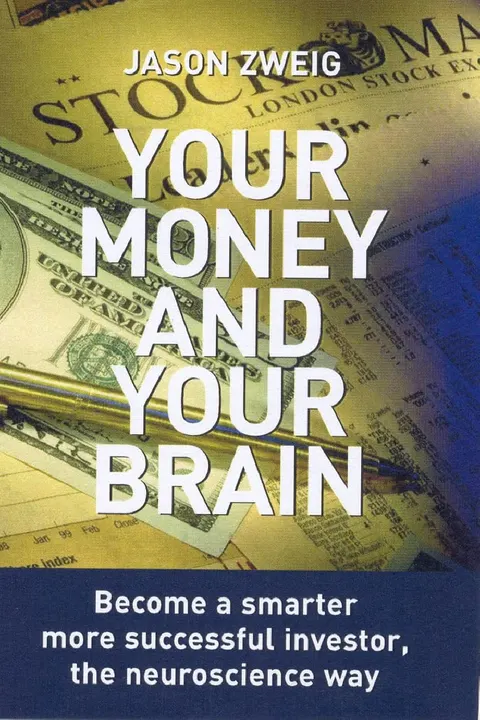
Cover of Your Money and Your Brain: How the New Science of Neuroeconomics Can Help Make You Rich
English only

Your Money and Your Brain: How the New Science of Neuroeconomics Can Help Make You Rich

How the New Science of Neuroeconomics Can Help Make You Rich

★★★★☆ 4.0/10 (2) 1 min read

Your Money and Your Brain is the most accessible and rigorous application of neuroeconomics to personal financial decision-making, written by Jason Zweig, Wall Street Journal columnist and editor of the annotated edition of Graham's The Intelligent Investor.

Affiliate CTA preview · enabled with monetization (phase 5).

Wall Street Journal columnist Jason Zweig explores neuroeconomics: the science of how the human brain makes financial decisions. He explains why the brain systematically pushes us to buy high and sell low, overestimate our abilities, and flee risk at the worst moments — packed with scientific experiments and practical advice for mastering financial instincts.

Our review

Your Money and Your Brain is the most accessible and rigorous application of neuroeconomics to personal financial decision-making, written by Jason Zweig, Wall Street Journal columnist and editor of the annotated edition of Graham's The Intelligent Investor. Zweig explains how the human brain, shaped by evolution to respond to immediate threats and rewards in the physical environment, generates responses that are systematically ill-suited to financial markets: the same neural circuit that makes us flee predators drives us to sell at market lows; the same reward system that once directed us toward food now leads us to chase stocks that have already risen. What distinguishes this book from other behavioral finance texts is that Zweig does not merely enumerate cognitive biases but connects each pattern to its neurological basis and suggests practical strategies to mitigate them. The style is accessible in the best sense — precise without being dry, approachable without being superficial — and the experiments cited are varied and well-contextualized. An essential companion read alongside Kahneman's Thinking, Fast and Slow.

Who it's for

For any individual investor who wants to understand why their financial decisions do not always match their rational intentions; fully accessible without prior financial or scientific training.

Key takeaways

  • The human brain is not designed for financial markets: the neural circuits of threat and reward generate responses that are predictably wrong in investment contexts.
  • The "reflexive brain" reacts automatically and immediately; the "reflective brain" can correct it, but requires conscious effort that market noise makes difficult.
  • The pain of losses is neurologically more intense than the pleasure of equivalent gains, which explains loss aversion and its consequences for portfolio management.
  • Automating investment decisions — fixed periodic contributions, systematic rebalancing — reduces exposure to the emotional biases the author documents.
Fact

Jason Zweig is a columnist for The Wall Street Journal and editor of the revised edition of Benjamin Graham's The Intelligent Investor published in 2003; Your Money and Your Brain was published in 2007.

Topics neuroeconomicsbehavioral financeinvestor psychologyJason Zweigdecision making