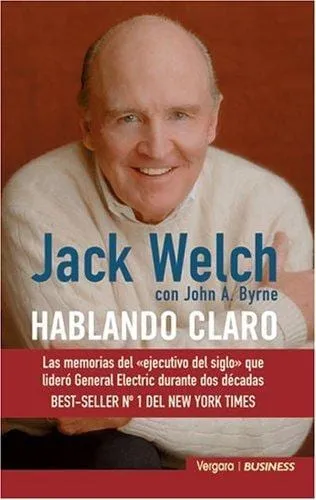
Cover of Jack: Straight from the Gut
Memoirs & biographies

Jack: Straight from the Gut

★★★★☆ No ratings 1 min read

For two decades Jack Welch was the world standard for executives: Fortune named him «manager of the century» and General Electric, which he ran from 1981 to 2001, went from $13 billion to over $400 billion in market value.

Affiliate CTA preview · enabled with monetization (phase 5).

The autobiography of the most influential executive of his generation. Jack Welch recounts his twenty years leading General Electric, multiplying its market value into the world's most valuable company: the ruthless early decisions of «Neutron Jack», the obsession with being number one or two in every business, differentiated talent evaluation, and the Six Sigma push.

Our review

For two decades Jack Welch was the world standard for executives: Fortune named him «manager of the century» and General Electric, which he ran from 1981 to 2001, went from $13 billion to over $400 billion in market value. «Jack: Straight from the Gut» is his autobiography and also the manifesto of a style: radical talent differentiation (reward the top 20%, remove the bottom 10%), the obsession with being number one or two in every market or exiting it, war on bureaucracy, and brutal candor as corporate policy. Read today, the book demands a double reading. As a management testimony it remains magnetic: rarely has an executive recounted his decisions this frankly. As a legacy it has aged controversially: part of GE's value was built on GE Capital and earnings-smoothing practices that ended badly after his exit, and «rank and yank» has been abandoned by most companies that imitated it. That is precisely why it deserves reading: it is the primary document of an era of American capitalism.

Who it's for

For those interested in management history and corporate leadership; best read with critical perspective on how the GE model aged.

Key takeaways

  • Talent differentiation — evaluating, rewarding, and removing without ambiguity — was the core of the Welch system, and its most contested inheritance.
  • «Fix it, sell it, or close it»: any business that couldn't be number one or two in its market left GE's portfolio.
  • Candor as policy reduces internal politics: problems get said in the room, not in the corridors.
  • GE's later decline shows the model's limits: short-term financial results can mask structural fragilities.
Fact

Welch ran General Electric for twenty years (1981-2001). After his departure, GE declined until it was removed from the Dow Jones in 2018 and eventually split into three companies.